
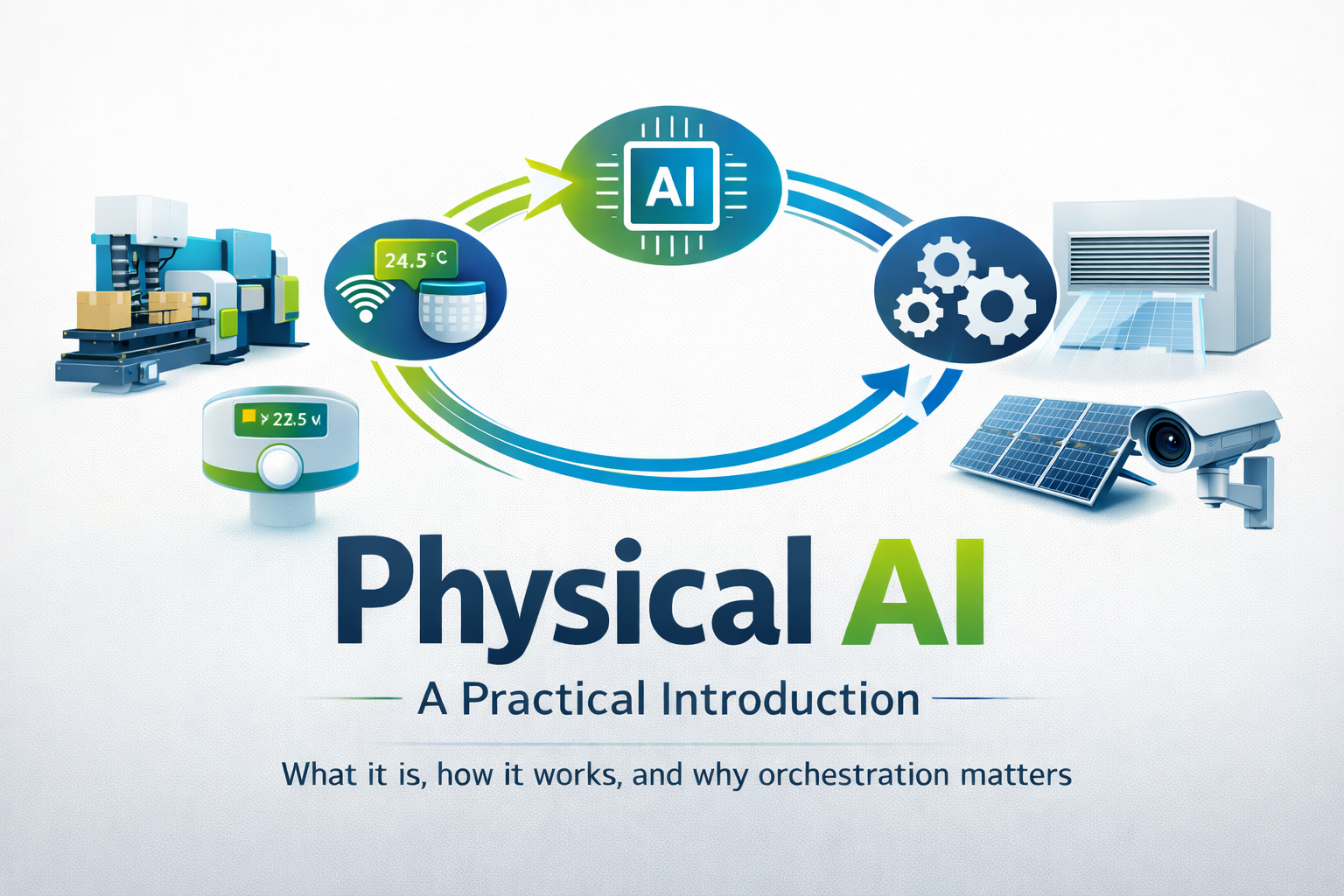
Artificial intelligence is no longer confined to digital environments. While early AI systems focused on analyzing data, generating insights, or supporting decisions within software applications, a growing class of systems now interacts directly with the physical world.
This shift has led to increased use of the term Physical AI across manufacturing, logistics, smart buildings, healthcare, retail, and infrastructure. However, the term is often used loosely. In some contexts it refers to robotics, in others to automation, edge AI, or intelligent infrastructure. As a result, there is still limited alignment on what Physical AI actually means in practical, deployable terms.
This article provides a clear, system-level overview of Physical AI, explains how these systems are typically structured, and outlines why orchestration and logic-based processing have become central to real-world deployments.
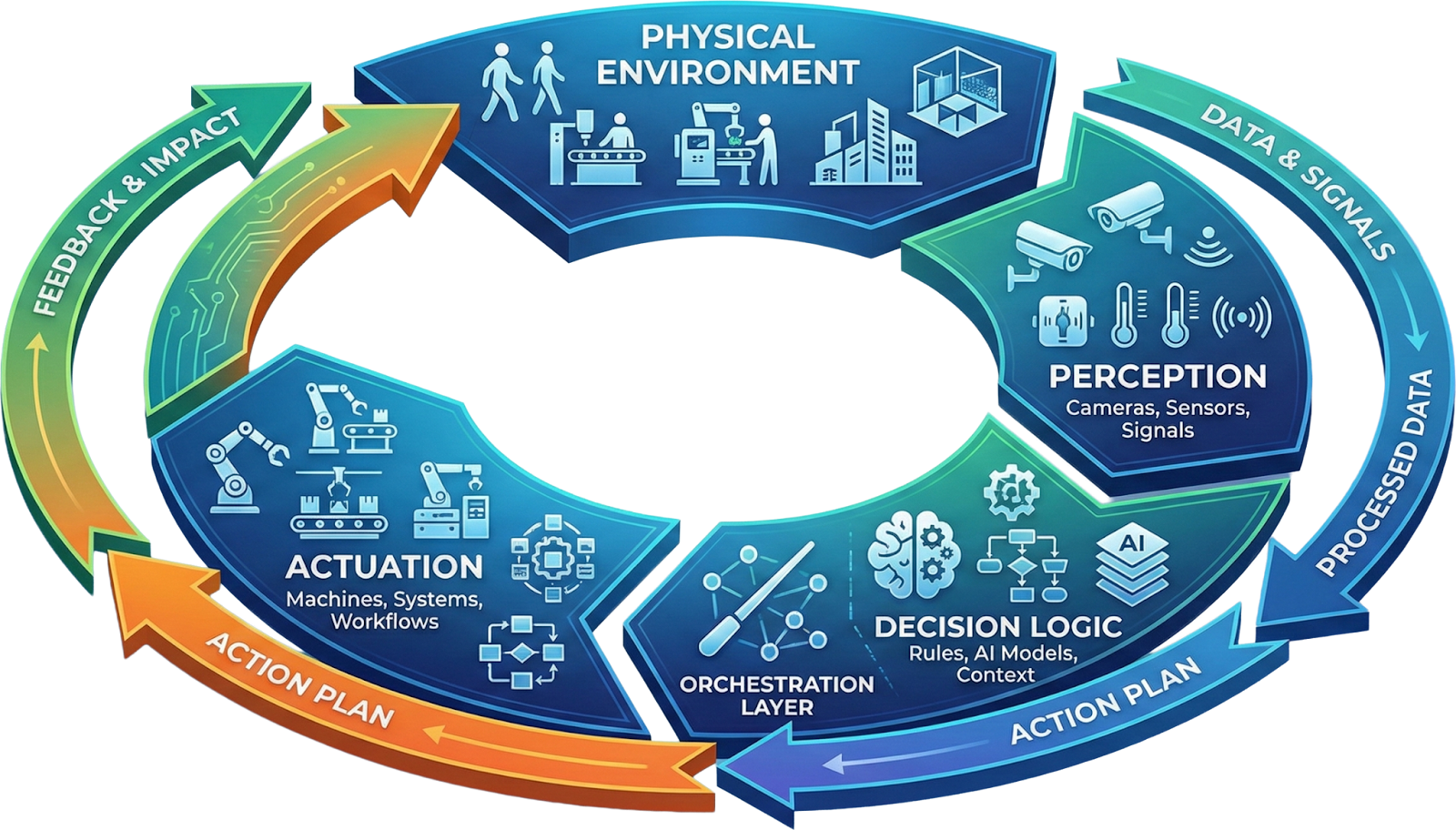
In practice, Physical AI refers to systems that interact with the physical environment through a continuous feedback loop. These systems observe real-world conditions, make decisions based on those observations, and trigger actions that influence physical processes, spaces, or workflows. They then observe the results of those actions and adapt accordingly.
This closed-loop behavior is the defining characteristic of Physical AI. Rather than producing insights or recommendations for human interpretation, Physical AI systems are designed to sense, decide, and act as part of an ongoing operational process.
Although Physical AI and traditional AI systems often use similar techniques such as machine learning and data processing, they operate under very different conditions.
Traditional AI systems typically run in cloud or enterprise IT environments, where latency is more tolerant and failures rarely have immediate physical consequences. Physical AI systems, on the other hand, must function reliably in real-world environments where inputs may be noisy or incomplete, response time can be critical, and failures can affect safety, operations, or regulatory compliance.
As a result, Physical AI places greater emphasis on system architecture, integration, and operational reliability, rather than on model performance alone.
Core Components of a Physical AI System
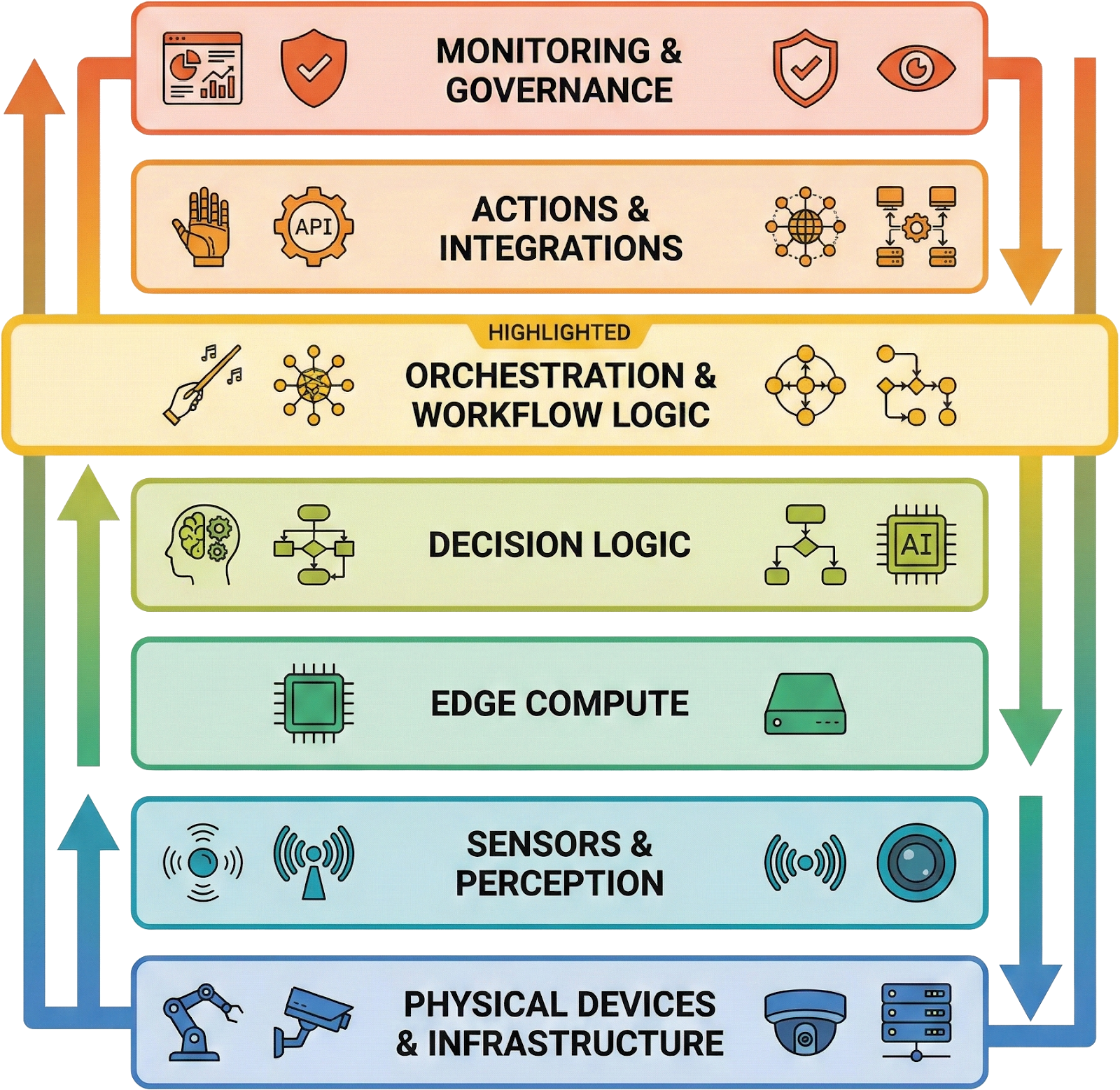
Despite differences in industry and use case, most Physical AI implementations share a common structural pattern.
They begin with perception, where signals are collected from the physical environment through sensors, cameras, or machine data. These signals are interpreted using decision logic, which may combine rule-based conditions, AI inference, and contextual information such as time, location, or system state.
Connecting decisions to real-world outcomes is an orchestration layer. This layer coordinates multiple inputs, applies logic consistently, and determines which actions should occur under specific conditions. Actions may include controlling machines, adjusting building systems, triggering alerts, updating digital signage, or initiating automated workflows. Monitoring and feedback mechanisms then provide visibility into system behavior and allow for human oversight.
Taken together, these elements form a system. In practice, Physical AI succeeds or fails not at the level of individual devices or models, but at the level of how well these components are integrated and coordinated.
As organizations move from experimentation to deployment, a common pattern emerges. Many Physical AI initiatives stall not because AI models fail to perform, but because the surrounding system becomes difficult to maintain and evolve.
Hard-coded logic, point-to-point integrations, and one-off workflows may work in proof-of-concept environments, but they often struggle to scale as requirements change or new systems are introduced. Without a clear orchestration layer, even small modifications can require significant reengineering.
Orchestration and logic-based processing provide a way to define and manage behavior across distributed systems without rebuilding the entire stack. They allow Physical AI deployments to evolve incrementally, integrate new inputs or actions, and maintain consistency as complexity grows.
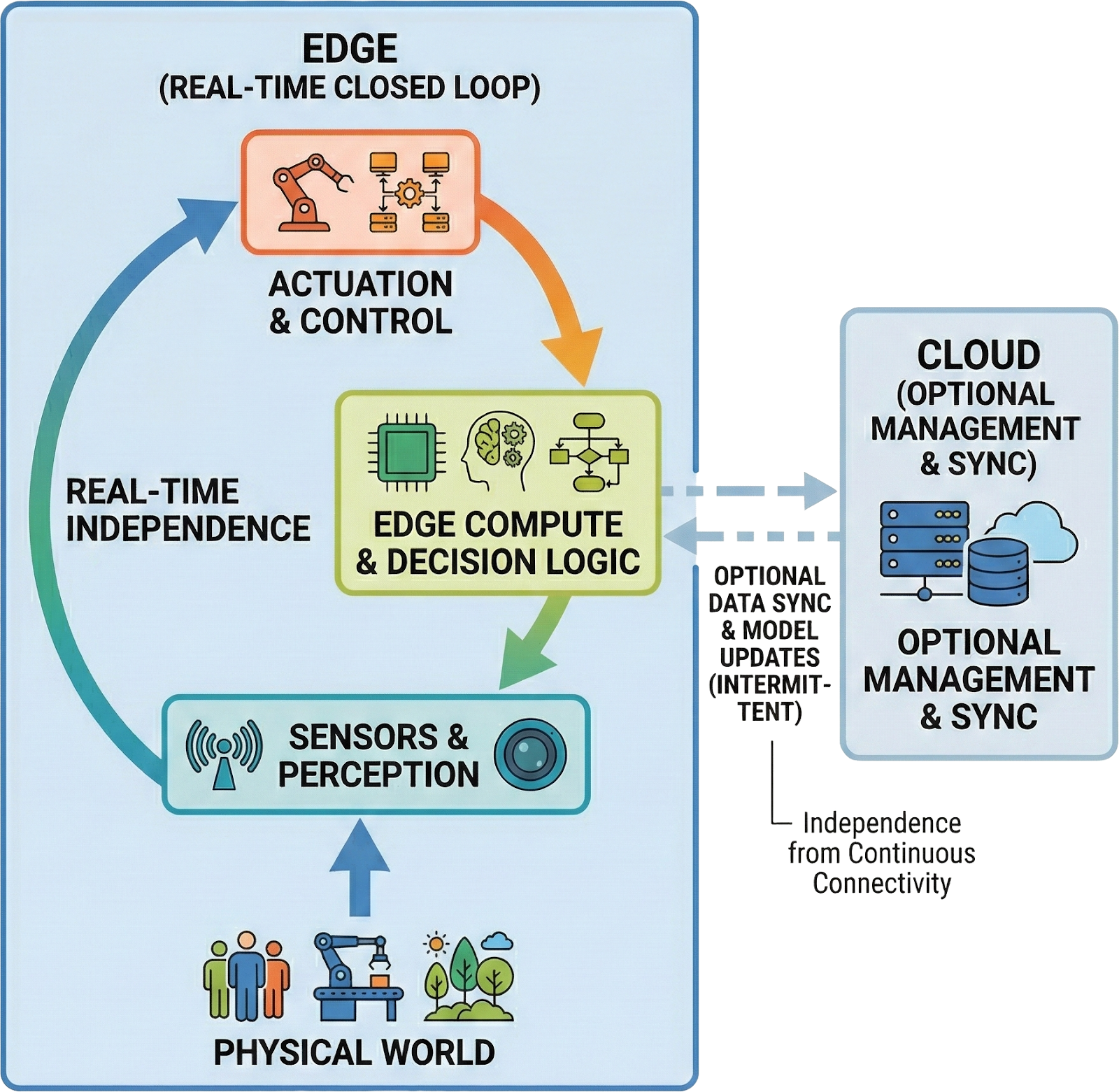
In many real-world environments, Physical AI systems operate under constraints such as limited connectivity, strict latency requirements, or data-privacy considerations. In these cases, orchestration must occur at the edge, close to the physical processes themselves.
Edge-based logic enables systems to remain responsive and operational even when cloud connectivity is limited or unavailable. At the same time, hybrid architectures can still leverage cloud platforms for analytics, coordination, or long-term data management.
Platforms such as Gravio are designed to address the orchestration layer within Physical AI systems. Rather than focusing solely on AI models or individual devices, Gravio provides a framework for logic-based processing and coordination at the edge.
Gravio enables sensors, cameras, AI inference, and external systems to be connected through configurable rules and workflows. Logic can be updated without deep reengineering, new inputs and actions can be added incrementally, and systems can operate independently at the edge or as part of a broader hybrid architecture.
In this role, orchestration platforms function as a control plane for Physical AI, bridging the gap between experimental intelligence and production-ready systems.
Physical AI reflects a broader transition in how intelligent systems are designed and deployed. Rather than operating solely within digital environments, these systems are increasingly expected to interact directly with physical processes, infrastructure, and human workflows. This shift introduces new constraints and complexities that extend beyond model performance, placing greater importance on system architecture, coordination, and operational reliability.
This article has outlined a practical definition of Physical AI, described the common components that make up such systems, and examined why orchestration and logic-based processing are critical in moving from experimentation to production. As organizations continue to explore Physical AI across different domains, these foundational elements remain consistent regardless of industry or use case.
Physical AI often starts with questions around architecture, integration, and where to begin. If you’re navigating these considerations, Gravio is built to support orchestration and logic-based processing in real-world environments.
We’re happy to exchange perspectives or explore ideas together. Feel free to Contact us to start a conversation.


