Gravio Blog
September 25, 2026

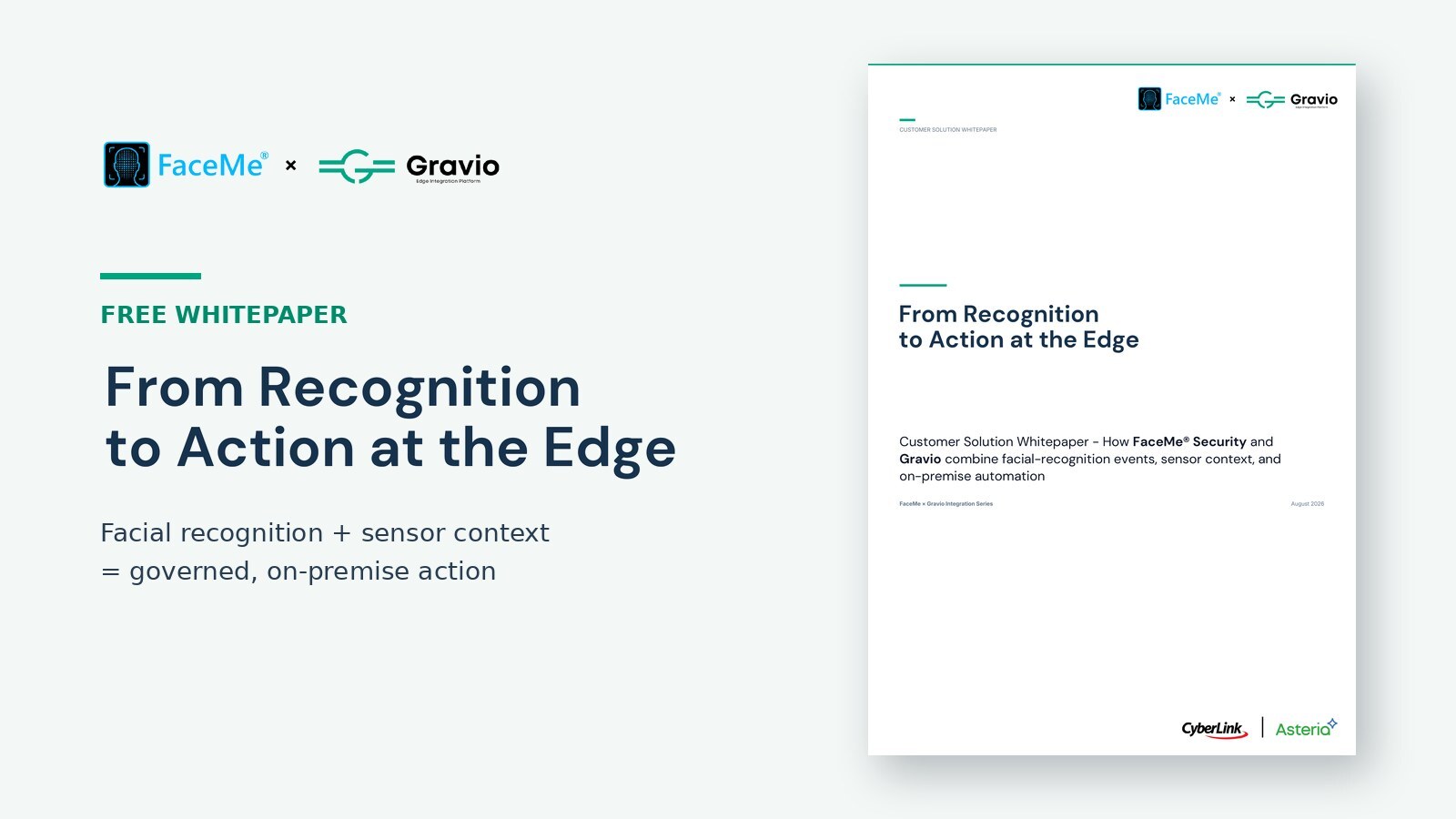
From Recognition to Action at the Edge: FaceMe® Security + Gravio Whitepaper

Facial recognition only creates value when it drives the right action. This free customer solution whitepaper from CyberLink and Asteria shows how FaceMe® Security and Gravio combine recognition events, sensor context and on-premise automation, with two integration patterns, five measurable outcomes, the reference architecture and a three-step fit assessment.
From Recognition to Action at the Edge: FaceMe® Security + Gravio Whitepaper

How FaceMe® Security and Gravio Turn Facial-Recognition Events and Sensor Context into Governed, On-Premise Action

Many facial-recognition projects stop at detection. A camera recognizes a face, an alert fires, and someone in a control room decides what to do. Recognition only becomes valuable when it drives the right action, and that is the gap this new customer solution whitepaper from CyberLink and Asteria sets out to close.

From Recognition to Action at the Edge explains how FaceMe® Security and Gravio work together: FaceMe Security contributes identity and face-derived intelligence, and Gravio contributes context, policy, orchestration and action. The integration was announced in a CyberLink and Asteria news release in April 2026.

‍

A Signal Is Not Yet a Decision

FaceMe Security can state with high confidence that the face at a camera belongs to an enrolled person, and through liveness detection, that it is a live person rather than a photo or replay. What it cannot say is whether this person, at this moment, in this place, should trigger any action at all.

Sensors have the opposite limitation. A door contact knows the exit opened; an occupancy counter knows two people passed on one badge. None of it says who is involved.

The operational decision needs both, evaluated together. The whitepaper walks through examples such as a hospital exit after hours, where only the combination of an enrolled at-risk patient, an open door, the time and escort status justifies alerting staff.

‍

What's Inside the Whitepaper

  • Two integration patterns: face-first, where a FaceMe Security recognition event reaches Gravio via webhook and Gravio adds context before acting; and sensor-first, where a door, machine, RFID reader or timer triggers Gravio, which calls FaceMe Security to verify identity on demand
  • Five customer outcomes, each tied to a specific capability, with a candidate metric for measuring it: context-aware edge decisions, local control of sensitive data, faster and more consistent responses, reusable integration across sites, and fewer nuisance alerts
  • The reference architecture: one webhook outbound, one secure HTTP call back, no middleware or message broker in between
  • FaceMe Security benchmarks and safeguards, including NIST FRTE results, iBeta PAD Level 2 liveness compliance, and on-premises data protection
  • Why the orchestration layer matters: connecting to building management, MES, ERP, access control and existing IoT, and keeping decisions running without Internet access
  • A three-step fit assessment you can run with your own team before contacting anyone, including honest answers to the objections that usually come up in privacy and procurement reviews

‍

Who Should Read It

This pairing fits organizations where identity events occur daily rather than occasionally, where today's response is a person reading a screen, and where the data cannot leave the premises. Think security and facilities teams, hospitals, manufacturing sites, logistics hubs and system integrators designing physical AI deployments.

If that does not describe your operation, the whitepaper is designed to tell you so early, before you spend a procurement cycle finding out.

‍

Download the Free Whitepaper

Fill in the short form below and you'll get instant access to the full whitepaper, plus a copy by email.

‍

Want to talk through a first workflow instead? Contact the Gravio team with one workflow, one camera location and one number that hurts.

Gravio — the platform for automation, integration and innovation at the edge.

Latest Posts
AI Readiness Assessment: A Practical Guide for Businesses
AI readiness is the capacity to adopt, integrate and derive sustained value from AI. This guide distils six established frameworks from Gartner, Deloitte, McKinsey, Oxford Insights, the European Commission and the ITU into one practical six-dimension model, with a self-assessment scorecard and a roadmap for whatever score you land on.
Tuesday, September 29, 2026
Read More
Airport AI: How Existing Cameras Can Improve Airport Operations
Airports can unlock more value from camera infrastructure by combining traditional computer vision with VQA for more contextual and flexible use cases. Gravio connects these visual insights with operational systems, applies business logic, and triggers actions, creating a practical way to test, refine, and scale airport AI without rebuilding the entire technology stack.
Tuesday, August 25, 2026
Read More