
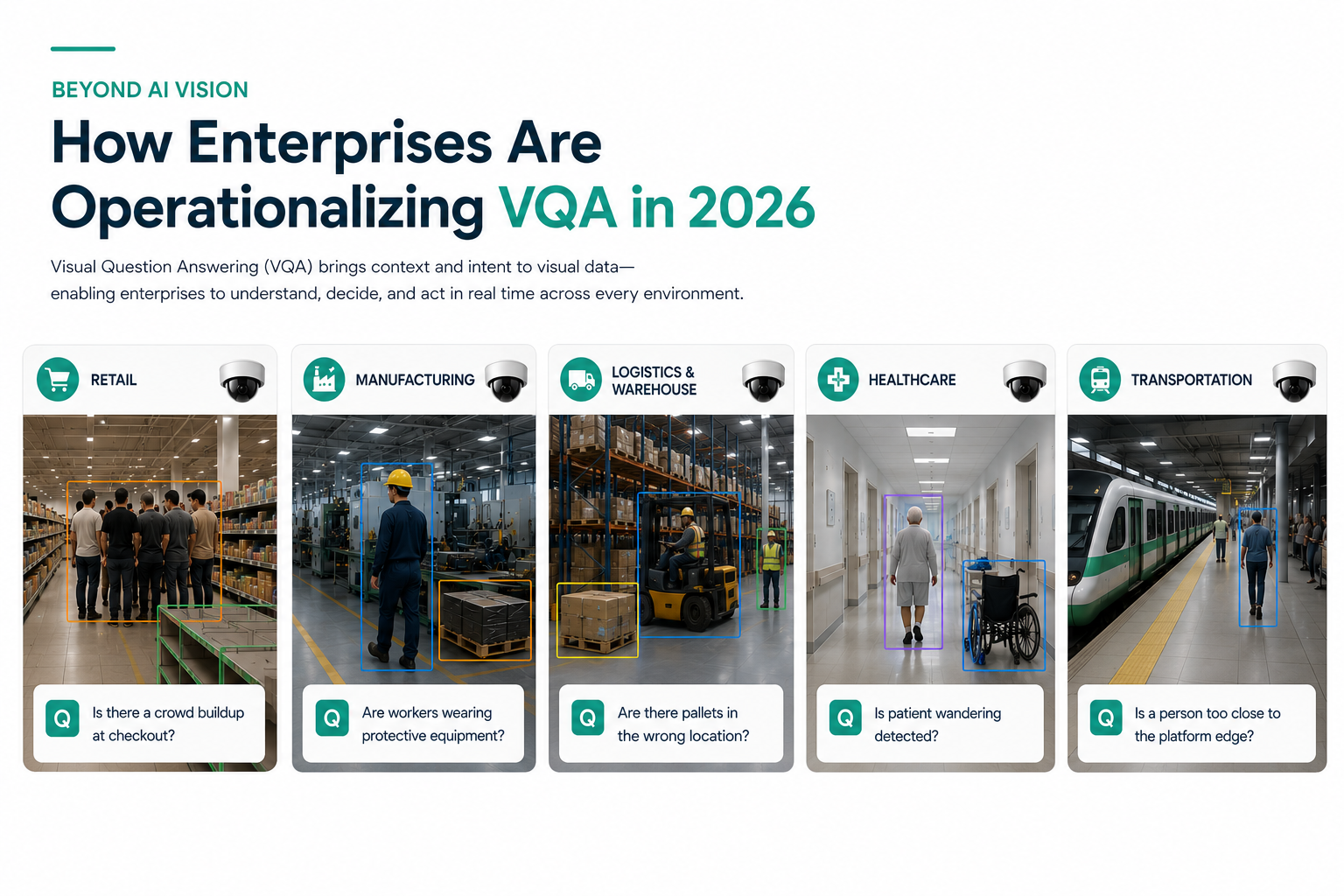
Factories, hospitals, warehouses, airports, retail stores, office buildings, and transportation systems are continuously generating enormous amounts of visual data through CCTV systems and IP cameras. Yet despite this infrastructure, many organizations still operate in a surprisingly reactive way. Security teams monitor screens manually, incidents are reviewed after they happen, and operational responses often depend on fragmented workflows and delayed escalation processes.
For years, surveillance systems were designed primarily to record events rather than understand them.
That expectation is beginning to change.
In 2026, the conversation around AI vision is no longer centered on whether machines can recognize objects or analyze images. Most enterprises have already seen AI detection demos, occupancy dashboards, and computer vision proof-of-concepts over the past few years.
The larger challenge now is operationalization:
How can visual intelligence integrate into real operational environments in a scalable and practical way?
This is where technologies such as Visual Question Answering (VQA), multimodal AI, and workflow orchestration are beginning to converge into something much larger than traditional computer vision systems.
New to VQA? Read our introductory guide, "What is VQA? How Could This Technology Disrupt Your Industry?", where we explore the fundamentals of Visual Question Answering and why it is becoming an important building block for next-generation AI vision systems.
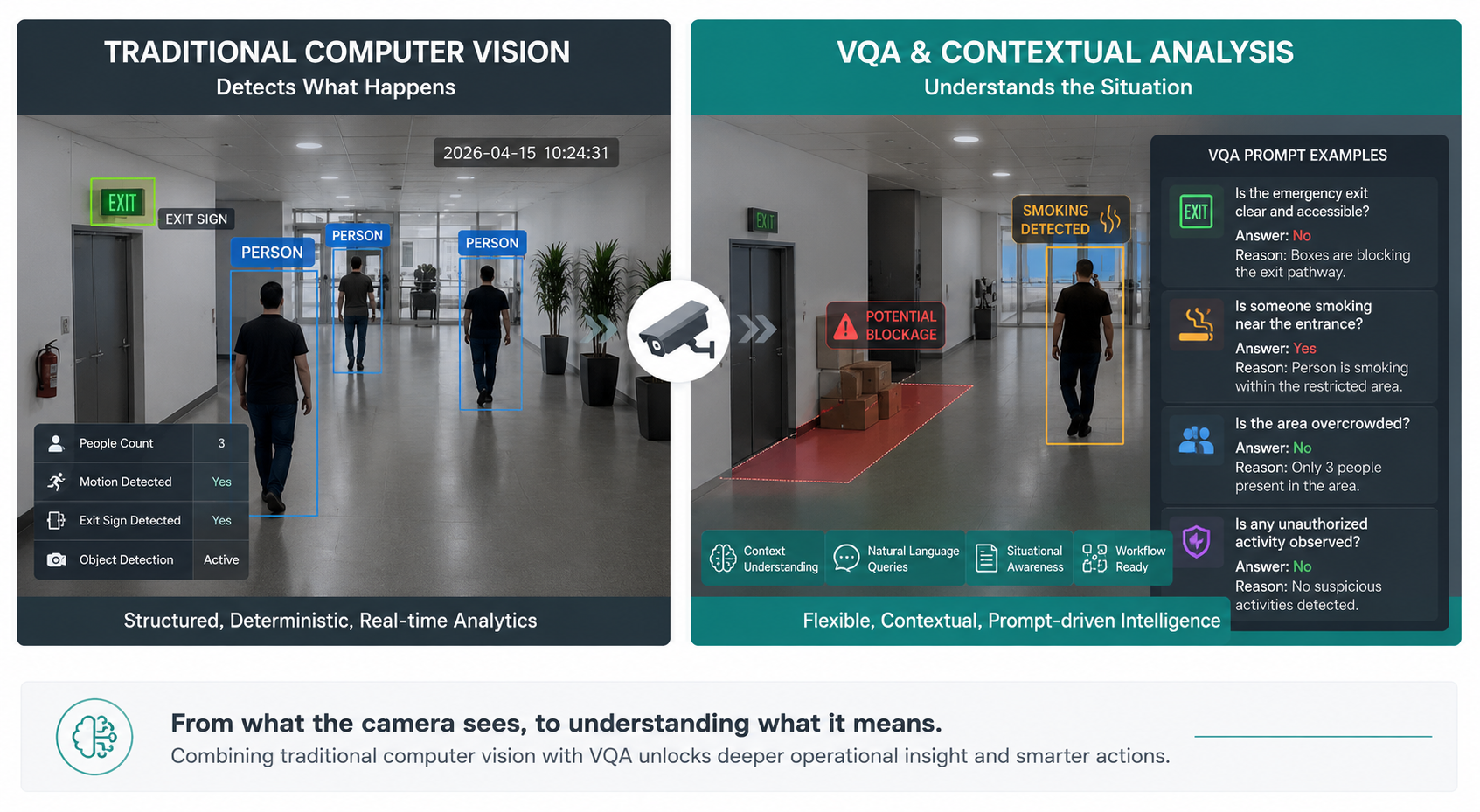
Traditional computer vision systems were typically built around highly specific tasks. A model might be trained to detect helmets, identify smoke, count people, or recognize certain objects under predefined conditions.
These systems remain extremely valuable today.
In fact, many modern deployments increasingly combine traditional computer vision together with VQA to create more flexible and context-aware operational systems.
A deterministic AI camera may detect motion, count occupancy, or identify a person entering a restricted area. VQA can then add another layer of contextual understanding by evaluating the scene dynamically through natural language prompts.
Questions such as:
can now be evaluated far more flexibly without organizations needing to build entirely new AI pipelines for every operational scenario.
This shift is important because it dramatically changes how enterprises can approach visual intelligence deployments.
Instead of designing isolated AI systems for every individual use case, organizations can increasingly build adaptable operational workflows capable of evolving over time.
Over the past several years, many organizations experimented with AI vision technologies through pilot projects and isolated deployments. Retailers explored occupancy analytics. Factories tested safety monitoring systems. Smart buildings deployed anomaly detection. Hospitals experimented with patient monitoring solutions.
Technically, many of these systems worked.
Operationally, however, enterprises encountered a different challenge entirely.
AI detections alone were not enough.
Organizations still needed:
In many cases, AI became yet another disconnected dashboard requiring human interpretation rather than reducing operational burden.
This is one of the biggest shifts happening in enterprise AI in 2026.
Organizations are becoming less interested in isolated AI analytics and far more interested in systems capable of coordinating operational responses across real-world environments.
The question is no longer:
“Can AI detect an event?”
The more important question has become:
“What happens after the event is detected?”
Consider a simple example inside a commercial building environment.
A VQA system identifies smoking near a restricted entrance. Another prompt identifies an emergency pathway that appears partially obstructed. A separate workflow observes that a server room door may have been left open outside operating hours.
Individually, these observations may appear relatively straightforward.
Operationally, however, every situation may require a completely different response:
The complexity is no longer visual analysis alone.
It becomes a workflow orchestration problem.
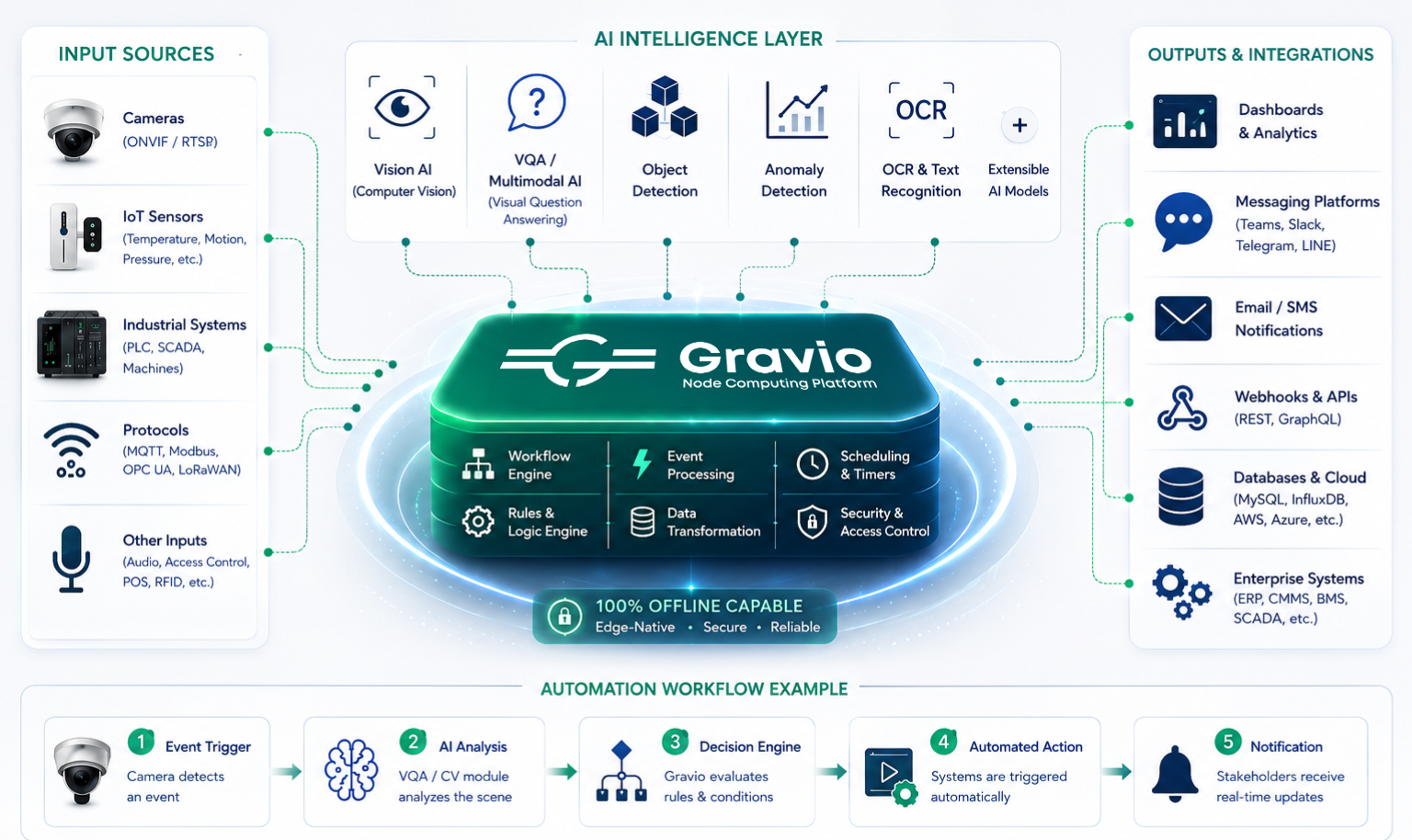
This is where platforms such as Gravio become increasingly relevant within modern AI deployments.
Rather than functioning purely as an AI inference layer, Gravio enables organizations to coordinate what happens after a VQA response is generated. AI outputs can be connected to:
A blocked corridor may trigger a facility management workflow. A repeated safety violation inside a manufacturing environment may escalate automatically based on predefined operational rules. A hospital notification may update internal systems while simultaneously alerting nearby staff.
The visual analysis itself is only the starting point.
The workflow is where enterprises derive operational value.
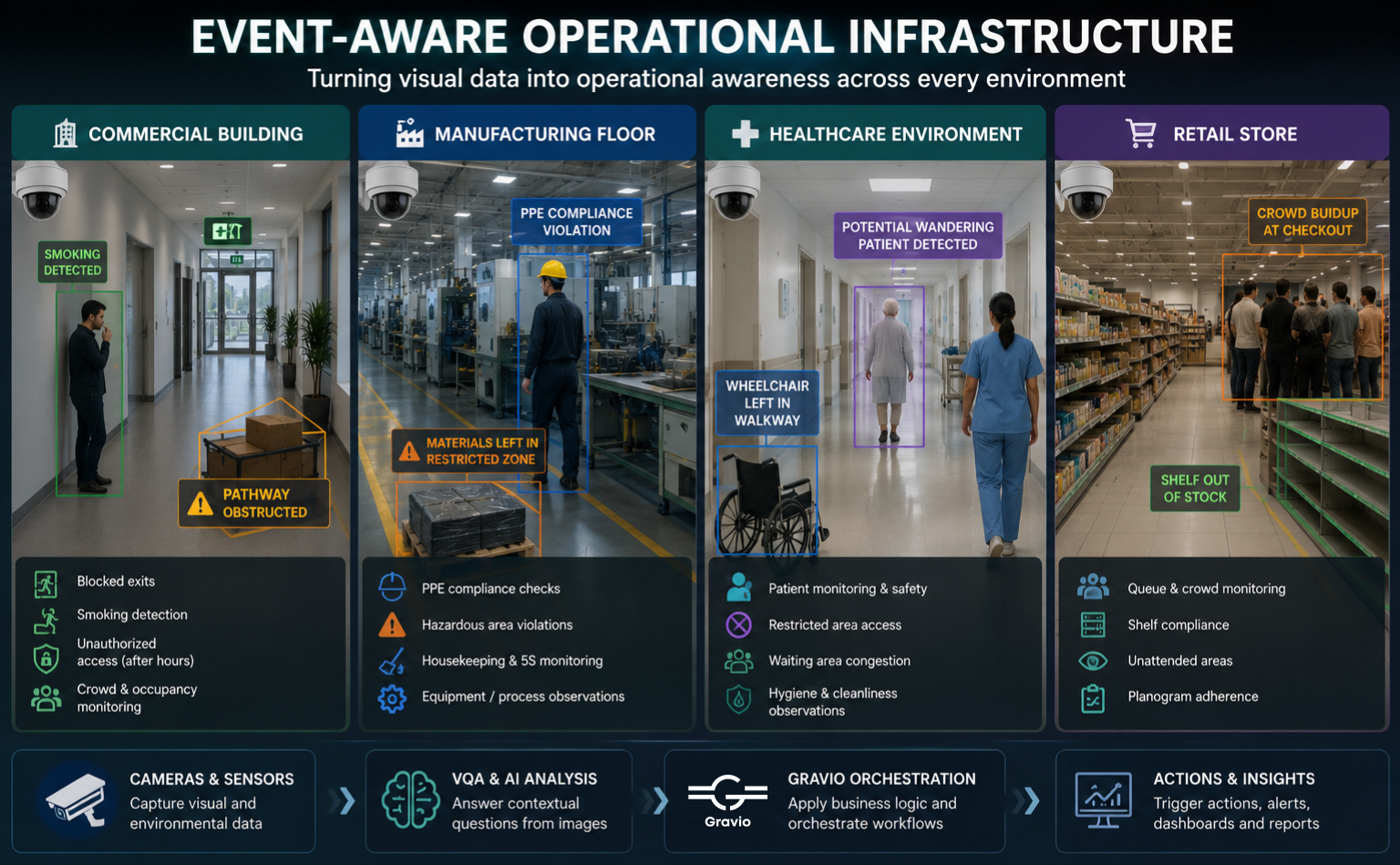
One of the more interesting developments emerging in 2026 is the gradual transformation of physical environments into event-aware systems.
In smart buildings, cameras are increasingly being used not just for surveillance, but for operational awareness. A blocked evacuation route, smoking near entrances, overcrowded waiting areas, or unauthorized after-hours activity may all require entirely different responses depending on the operational environment.
Inside manufacturing facilities, visual intelligence is increasingly being explored for:
Rather than replacing existing systems, VQA often complements traditional computer vision by adding a more flexible layer of contextual analysis. Organizations can introduce new prompts and workflows far more rapidly without redesigning entire AI pipelines every time a new operational requirement emerges.
Retail environments are also beginning to evolve in similar ways. Queue buildup, unattended checkout counters, empty promotional displays, or overcrowded customer areas may all become part of broader operational awareness systems connected to dashboards, escalation workflows, and facility coordination tools.
Healthcare environments present another strong example of this transition. Hospitals and elderly care facilities are increasingly exploring how visual intelligence can support staff without creating additional operational burden.
At Shinsei Hospital in Japan, Gravio was initially deployed using conventional Computer Vision and facial recognition technologies to support dementia patient monitoring and improve caregiver situational awareness. As these healthcare environments continue evolving toward more context-aware operational systems, the next phase includes layering Visual Question Answering (VQA) capabilities on top of existing infrastructure, enabling prompts such as “Is anyone lying on the floor?” to help detect potential incidents like patients fainting in stairwells or restricted areas while supporting faster response workflows for hospital staff.
Across industries, the broader pattern remains consistent: visual intelligence is becoming integrated into operational infrastructure rather than remaining isolated inside
standalone AI systems.
One of the biggest advantages of modern VQA systems is flexibility.
Traditionally, introducing new computer vision use cases often required:
Prompt-driven VQA introduces a far more adaptable approach.
Organizations can increasingly explore new operational workflows simply by adjusting prompts, logic layers, and orchestration flows rather than rebuilding entire AI pipelines from scratch.
This flexibility becomes especially valuable in real-world enterprise environments where operational requirements constantly evolve.
A facilities team may initially deploy VQA for corridor monitoring, then later expand into housekeeping observations, occupancy awareness, or compliance workflows. A manufacturing environment may begin with safety checks before extending into process observation and operational coordination.
The underlying infrastructure remains largely the same.
The workflows evolve around it.
As organizations move from pilot projects toward broader operational deployments, flexibility becomes increasingly important.
Different environments have different infrastructure requirements. Some organizations may prefer centralized cloud analytics, while others may require more localized processing, hybrid deployments, or tighter integration with existing operational systems.
In many cases, enterprises are not looking for a single AI product.
They are looking for deployable operational systems capable of integrating cameras, AI models, sensors, messaging platforms, dashboards, and automation workflows into a coordinated environment.
This is where orchestration platforms such as Gravio become particularly valuable, allowing organizations to connect visual intelligence into broader operational processes without heavily redesigning existing infrastructure.
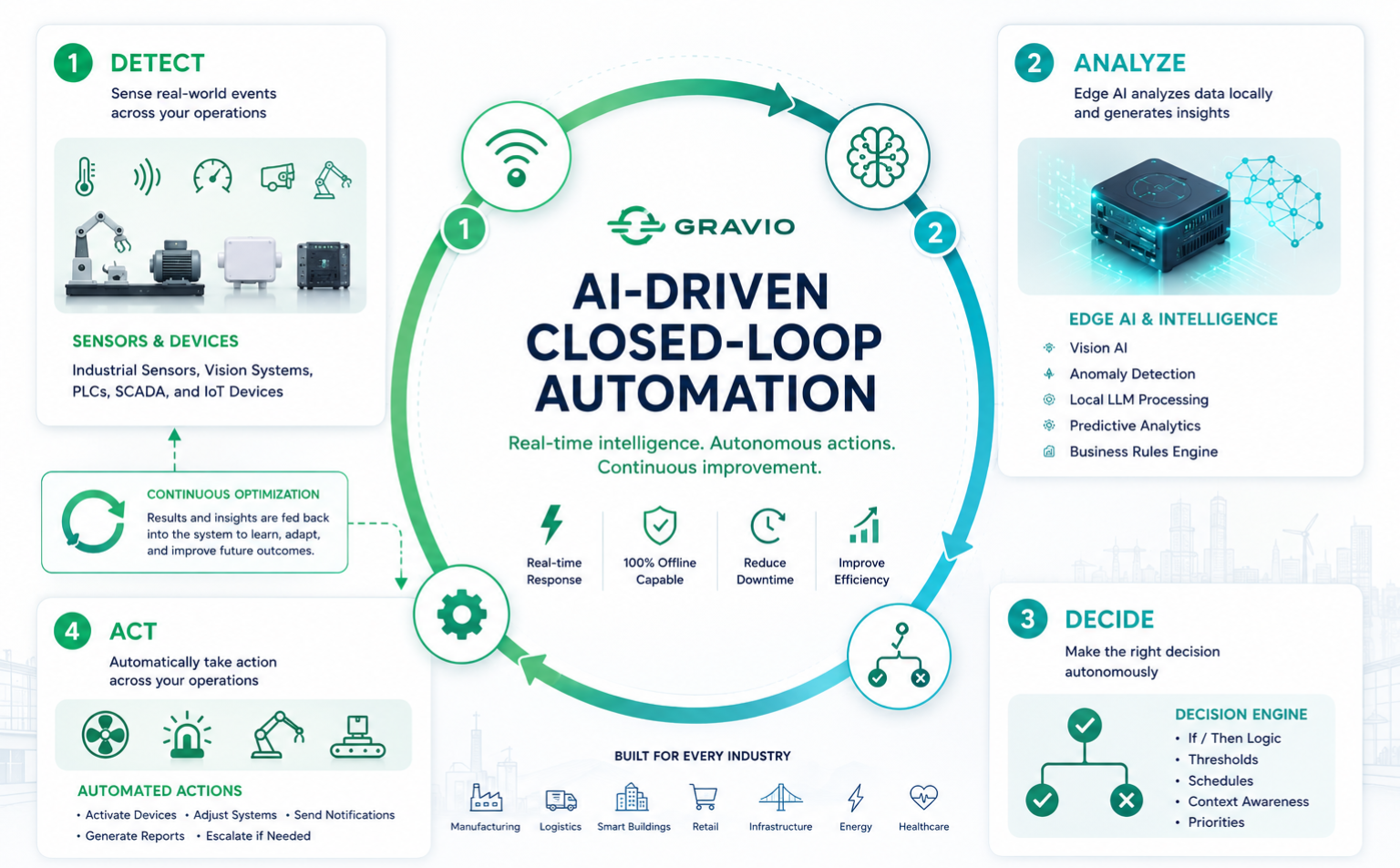
The enterprise AI market is gradually moving beyond isolated AI capabilities and toward operationally integrated systems.
In many ways, organizations are beginning to realize that intelligence alone is not enough. AI systems must also participate in workflows, escalation logic, operational coordination, and downstream processes if they are to create meaningful business impact.
This broader evolution is also closely related to what many in the industry are beginning to describe as Physical AI — systems capable of sensing, interpreting, and coordinating actions across real-world environments. While robotics often dominates the conversation, many of the earliest deployments of Physical AI are already emerging through operational infrastructure such as cameras, sensors, automation systems, and orchestrated AI workflows.
The combination of:
is creating new possibilities for enterprises looking to modernize physical environments without completely rebuilding existing infrastructure.
The next phase is not simply adding AI.
It is operationalizing intelligence across real-world systems.
Visual Question Answering is no longer just an experimental AI capability or a computer vision enhancement.
In 2026, it is increasingly becoming part of a broader shift toward operationally aware systems capable of understanding physical environments, coordinating workflows, and automating responses across real-world enterprise environments.
At the same time, traditional computer vision continues to play an important role alongside VQA, with many organizations combining both approaches to create more flexible and context-aware operational systems.
Yet one of the most important lessons emerging from enterprise deployments is that AI detection alone is rarely sufficient.
Real operational value comes from:
By combining visual intelligence technologies with orchestration platforms such as Gravio, organizations can move beyond passive monitoring systems and begin building environments that are not only intelligent, but operationally responsive.
The future of enterprise AI is not simply about seeing events.
It is about operationalizing them.
As organizations continue exploring the next evolution of AI Vision, the focus is rapidly shifting from standalone AI models toward deployable operational systems that integrate intelligence, workflows, and automation.
If you are evaluating how VQA or operational AI could apply within your organization, contact the Gravio team to discuss real-world deployment strategies and enterprise use cases.


