
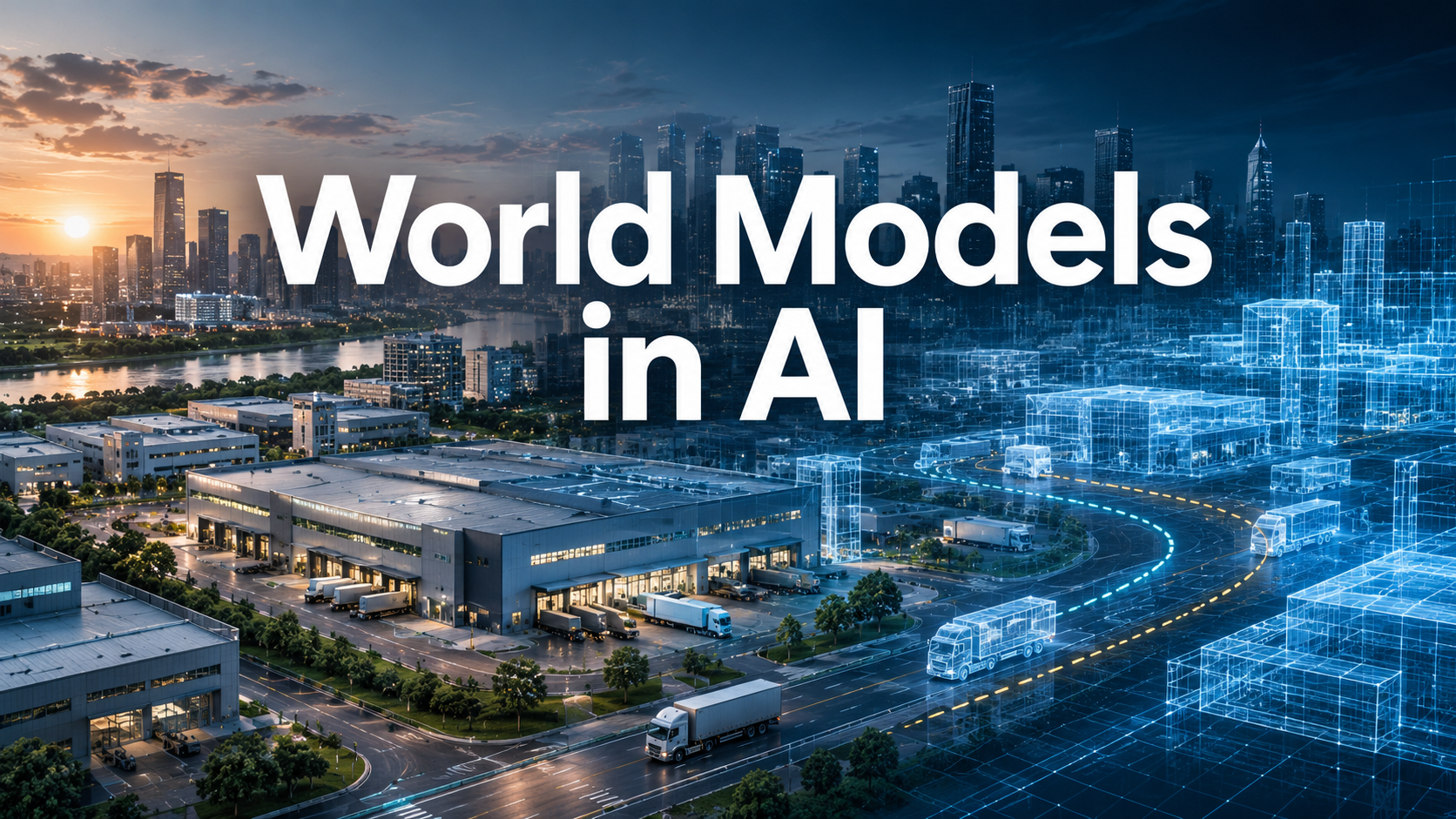
Key Takeaways
A world model in AI is a system that learns how an environment works: how objects move, how situations change over time, and how actions affect outcomes. Instead of only recognizing what is in a scene, a world model predicts what is likely to happen next. This makes world models a foundation of physical AI, meaning AI that perceives, reasons about, and acts in the real world.
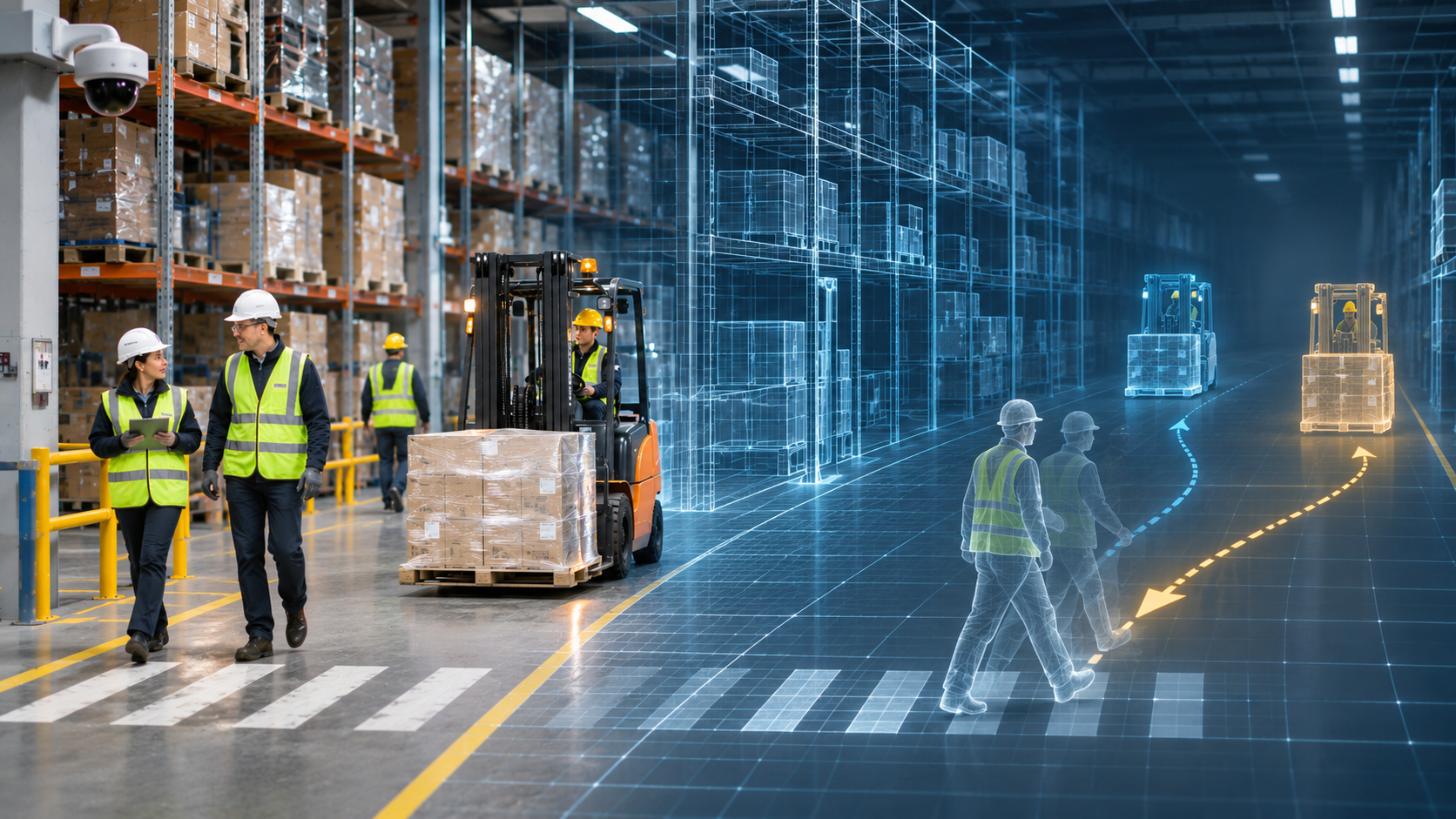
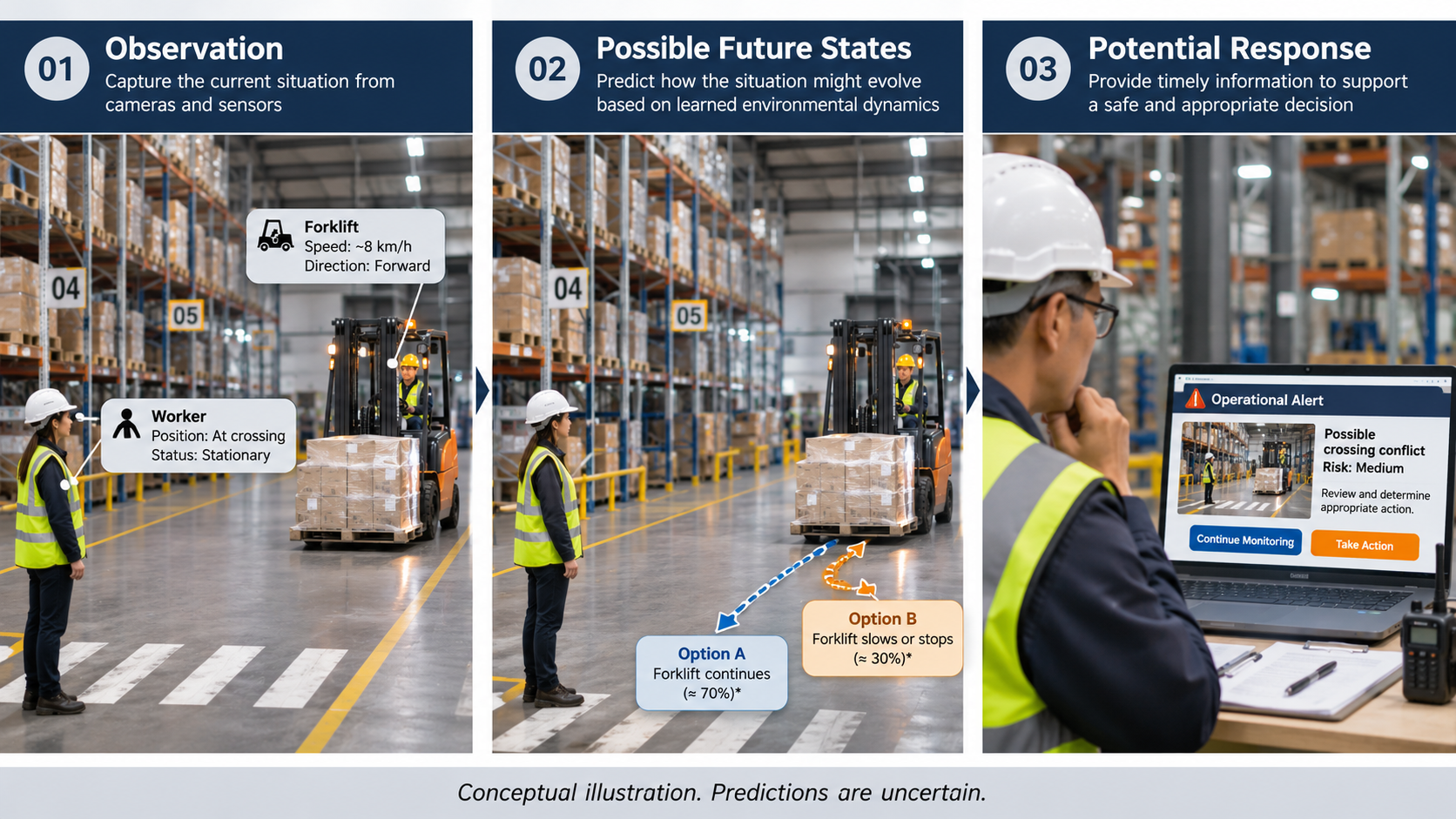
A forklift moves through a busy warehouse. A worker approaches a pedestrian crossing while another vehicle prepares to reverse from a loading bay.
Existing computer vision systems can identify these objects, track their movements and estimate their trajectories. Evaluating how the situation might evolve under different conditions, however, introduces a more complex challenge.
This is one of the problems being explored through world models, an area of artificial intelligence receiving renewed attention across robotics, autonomous systems and physical AI.
A world model is a learned representation of an environment that enables an AI system to predict how that environment may evolve, including, in some architectures, the consequences of different actions.
For businesses, the possibilities extend beyond robotics. Manufacturing facilities, warehouses, commercial buildings and public infrastructure all contain physical processes that could benefit from predictive intelligence.
Realising this potential will depend on more than model capabilities. Businesses must also be able to integrate, afford, govern, trust and act upon that intelligence.
The idea of modelling an environment to anticipate future conditions is not new. Robotics, reinforcement learning and control engineering have explored related principles for decades.
An influential milestone in modern learned world-model research was the 2018 paper World Models by David Ha and Jürgen Schmidhuber, which demonstrated how learned environmental representations could support agent training through simulated experiences.
Recent advances in computing, neural network architectures and large-scale multimodal datasets have renewed interest in developing models with broader predictive and simulation capabilities.
While large language models (LLMs) primarily learn relationships within language, vision-language models (VLMs) combine visual and linguistic information to interpret scenes, recognise relationships and reason about observations.
Conventional computer vision can already perform object tracking, motion estimation and trajectory prediction. World models place greater emphasis on learning environmental dynamics and anticipating changes in future states.
These capabilities overlap rather than represent successive levels of intelligence.
Some world models generate simulated visual observations, while others predict changes within compact internal representations. A robotic arm evaluating different gripping positions, for example, may only need a representation of the object's expected behaviour rather than a photorealistic simulation of its surroundings.
Action-conditioned world models can also evaluate how environmental conditions might change in response to different actions, supporting planning and decision-making.
However, three distinct capabilities matter when evaluating these systems:
A convincing simulation of a forklift braking near a pedestrian does not establish that the model can accurately predict its stopping distance.
Prediction errors can also accumulate over longer simulation horizons, making distant outcomes increasingly uncertain.
These distinctions are fundamental to physical AI, the broader field concerned with artificial intelligence that perceives, interprets and interacts with physical environments.
Current world-model research reflects several complementary approaches to environmental simulation, prediction and planning.
NVIDIA Cosmos 3 combines visual reasoning, world generation and action generation within a foundation-model family designed for physical AI development. Its applications include synthetic training data generation and the development of specialised robotic models.
Google DeepMind approaches environmental modelling through interactive simulation. Announced in October 2026, Genie 4 generates interactive environments that respond to user actions while incorporating synchronised audio and additional reasoning capabilities.
Its official model card identifies ongoing challenges involving spatial accuracy, complex physical interactions and consistency across longer simulations.
Meta's V-JEPA 2 explores predictive representations learned from video. Rather than reconstructing every visual detail, its approach focuses on representations that support anticipation and planning, including experimental robotic manipulation tasks.
Research such as DreamerV3 demonstrates how agents can improve their behaviour by evaluating imagined experiences within learned environmental models.
Together, these developments illustrate how world models can serve different purposes, from generating training environments to evaluating possible actions and learning predictive representations.
Their commercial maturity varies considerably. Research demonstrations and available development tools should be distinguished from independently validated industrial applications.
For enterprises, the important consideration is identifying which capabilities address an existing operational requirement.
Digital twins, physics-based simulation, model predictive control (MPC) and conventional predictive analytics already support physical modelling and operational decision-making across industries.
World models may complement these technologies by learning environmental relationships that are difficult to describe explicitly through conventional engineering methods. Future architectures could combine learned representations with physical equations, engineering constraints and established control systems.
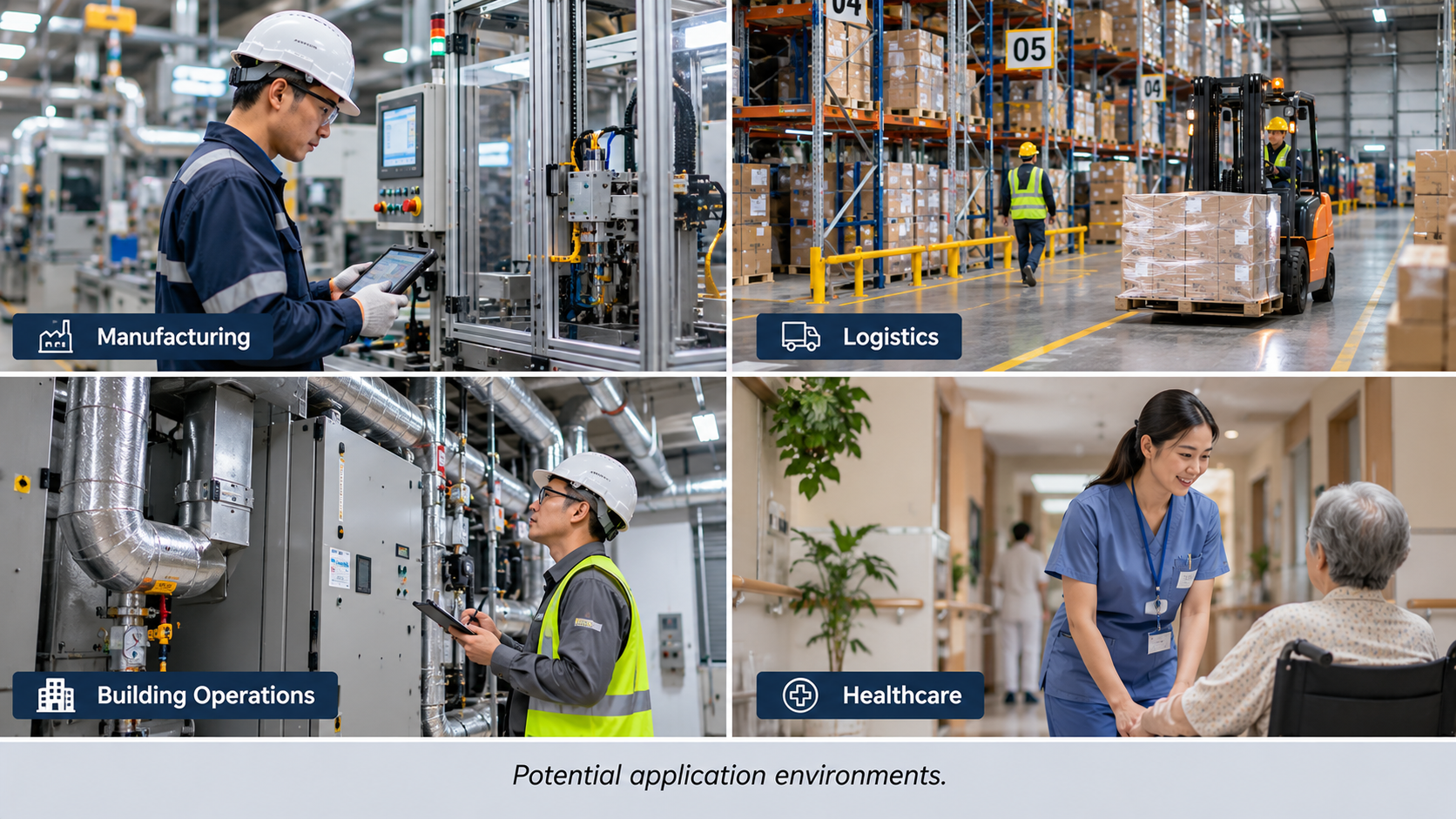
In manufacturing, predictive representations could help evaluate interactions between machinery, materials and production processes, complementing existing predictive maintenance technologies.
Logistics facilities could explore their use in anticipating congestion, evaluating equipment movements and assessing developing operational risks.
Commercial buildings present opportunities involving relationships between occupancy, ventilation, equipment performance and energy consumption.
Healthcare and assisted-living environments may benefit from predictive monitoring of movement and activity patterns, with appropriate clinical evaluation and privacy safeguards.
These prospective applications share familiar business objectives: improving efficiency, reducing manual workload and supporting better-informed operational decisions.
A world model should therefore be assessed against the additional value it provides over established technologies, not simply the sophistication of its underlying architecture.
For many well-defined industrial problems, conventional computer vision, statistical forecasting or deterministic automation may remain the more effective solution.
Through Gravio's engagements with businesses and technology providers at industry conferences and exhibitions, several recurring concerns have emerged around AI adoption.
These experiences suggest that technological capability is only one part of the enterprise AI equation. Infrastructure, governance, cost and operational trust can be equally significant barriers.
Many enterprises operate machinery and software systems that were never designed for advanced AI integration. Information may be fragmented across devices, lack historical context or be difficult to access consistently.
Even extensive camera coverage cannot capture every variable influencing a physical environment.
A camera observing a forklift may provide information about its position, direction and estimated speed, but payload weight, braking capability and floor conditions may require additional operational data.
This illustrates partial observability, where a system has access to only part of the information relevant to environmental behaviour.
Combining video, sensor readings, equipment telemetry and operational metadata can provide additional context. Temporal synchronisation, spatial calibration and historical observations may also be important.
However, connected data must be compatible with the selected AI model. Additional pre-processing, suitable input interfaces or model adaptation may be required.
Physical AI frequently involves observations of workplaces, public spaces and other environments where individuals may be identifiable.
Regulatory frameworks such as Singapore's Personal Data Protection Act (PDPA) and the European Union's General Data Protection Regulation (GDPR) introduce considerations around data processing, access, retention and international transfers.
Edge-first and hybrid architectures can help organisations control how sensitive information moves between systems. Local processing may reduce unnecessary data transfers, although regulatory compliance depends on the wider deployment and governance practices rather than processing location alone.
Cloud-based AI services offer access to advanced computing capabilities without substantial initial hardware investment. However, consumption-based inference costs can increase considerably as deployments expand.
On-premises AI introduces different considerations, including hardware expenditure, energy consumption, maintenance and utilisation.
Even smaller foundation models may require specialised computing infrastructure. NVIDIA's Cosmos 3 technical overview distinguishes its 16-billion-parameter Nano model, designed for workstation-grade computing, from its 64-billion-parameter Super model targeting data-centre infrastructure.
For many businesses, smaller, task-appropriate models may offer a more commercially accessible entry point than general-purpose foundation models.
Hybrid architectures provide additional flexibility by distributing workloads across ordinary edge devices, accelerated local systems, on-premises servers and cloud services.
Certain AI applications benefit from event-driven processing. Motion detection, sensor readings or lightweight computer vision can determine when more demanding inference is required, reducing unnecessary computational workloads.
Predictive models may require a different approach. Some depend on continuous observations or sufficient historical context to maintain meaningful environmental representations.
An effective architecture may therefore combine lightweight monitoring, buffered observations, periodic state updates and event-triggered deeper analysis.
Inference frequency should reflect the model's data requirements, prediction horizon and operational latency constraints.
A recurring observation from Gravio's industry engagements is that businesses often invest in AI detection without fully considering what happens afterwards.
Recognising a defect or potential safety violation creates information. Operational value emerges when that information contributes to an appropriate response and measurable improvement.
Businesses must also consider whether AI is sufficiently consistent for the responsibility being assigned to it. For repetitive, well-defined processes, conventional automation or robotic process automation (RPA) may remain more suitable.
Gravio's approach separates AI inference from predefined workflow execution.
Rather than asking a generative AI model to independently manage an entire operational process, its responsibility can be constrained to a specific interpretation task. A visual question answering model might return YES or NO to determine whether a defined condition appears present.
The automation workflow then evaluates that output according to configured rules.
A valid AI response is not necessarily a correct inference. Sensor corroboration, repeated observations, output validation and appropriate fallback behaviour can help manage uncertainty. Deterministic workflows themselves can also encounter configuration errors, communication failures and incorrect inputs.
Performance should therefore be assessed through both model-level and operational metrics, including prediction accuracy, false alerts, missed events, prediction lead time, inference latency and response effectiveness.
Human-in-the-Loop remains essential where decisions require judgement, authorisation or accountability. In safety-critical applications, AI-assisted monitoring and human oversight must complement established, certified industrial safety mechanisms.
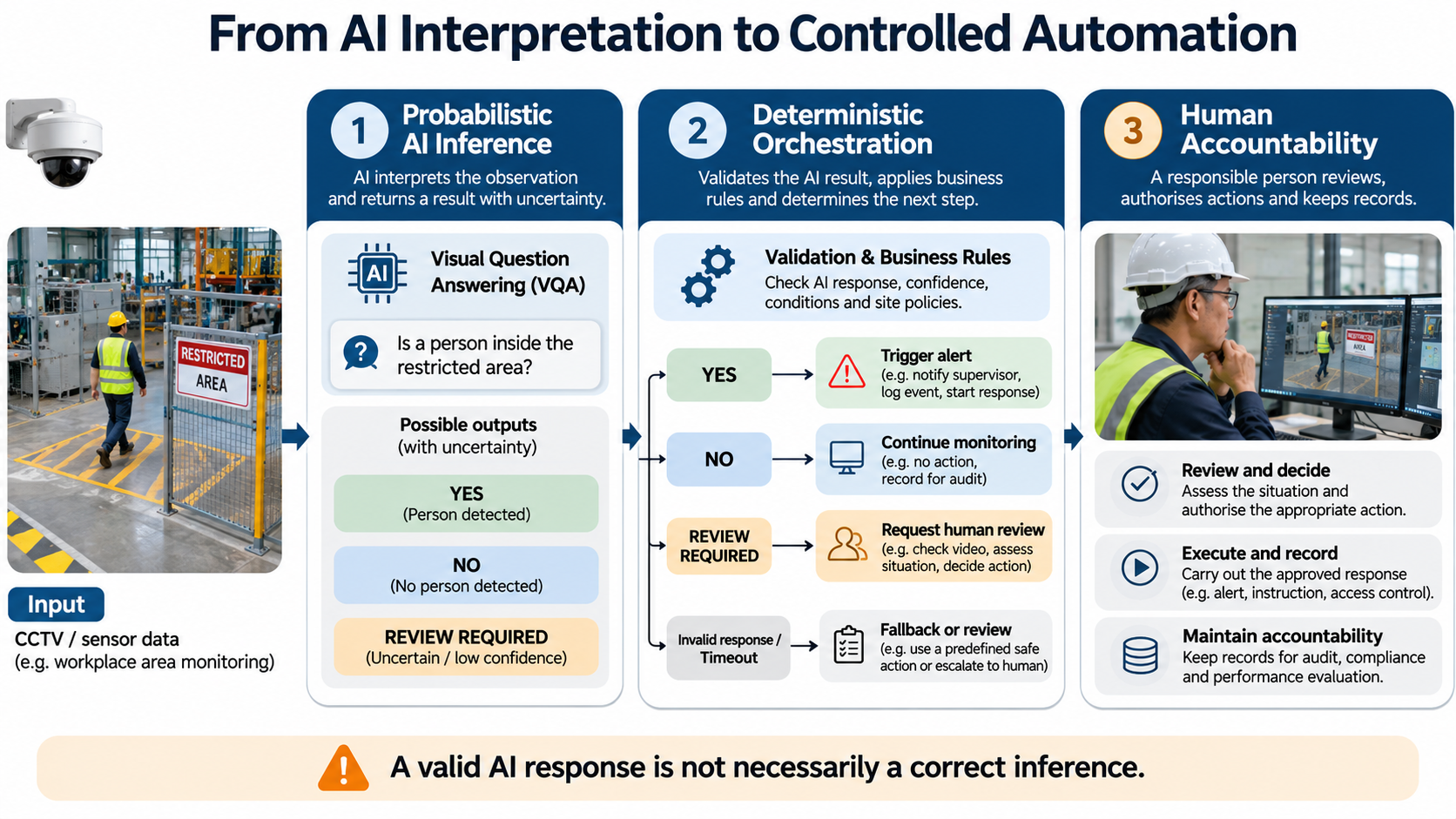
The challenges of operationalising physical AI highlight the importance of separating predictive intelligence from operational authority.
Drawing on established system integration, feedback-control and intelligent automation principles, Gravio proposes a conceptual Physical AI Integration Loop for connecting AI capabilities with enterprise operations.
The framework consists of six interconnected stages:
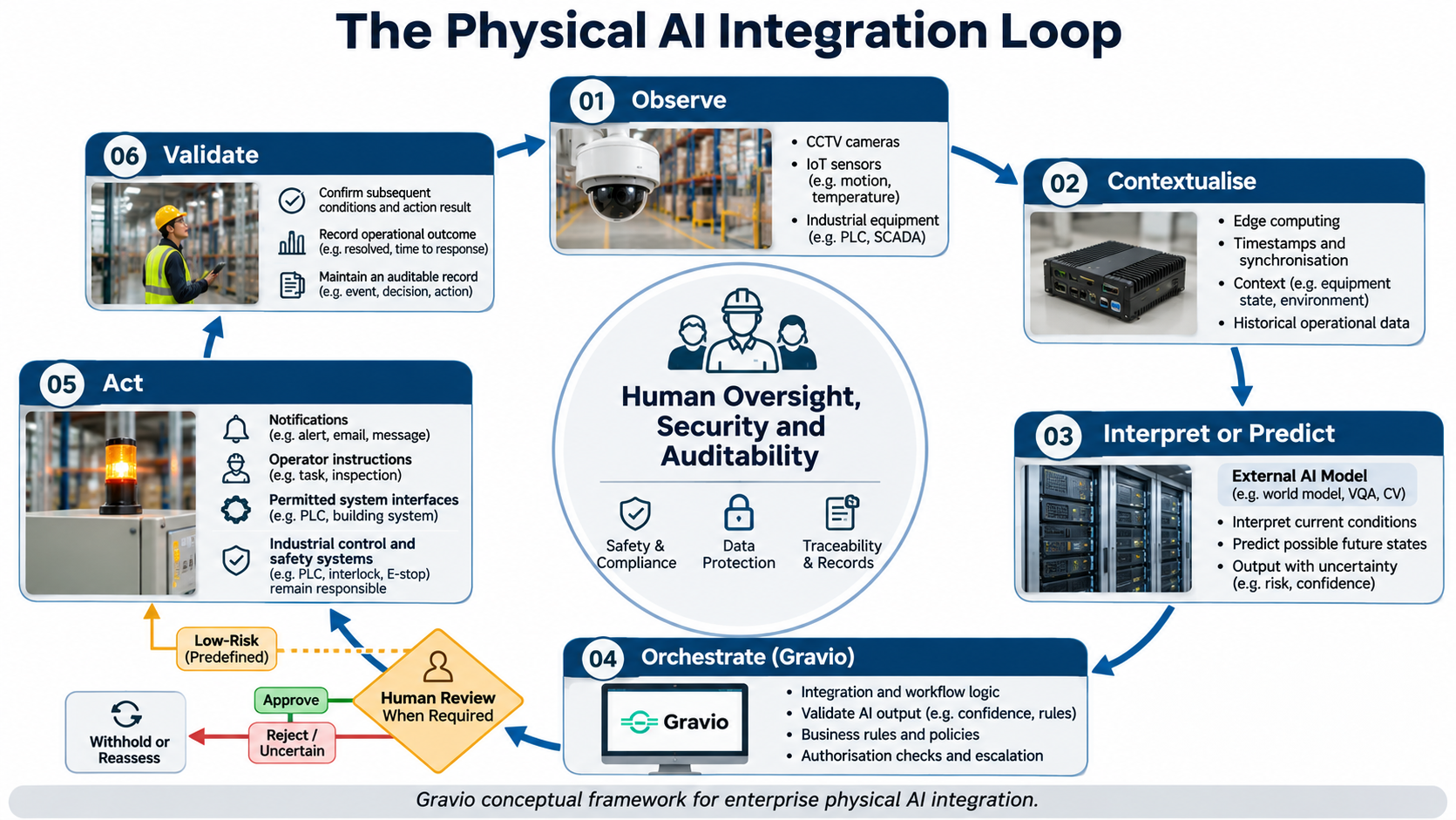
Human oversight, security and auditability extend across the framework.
Consider a predictive model identifying a developing congestion risk within a warehouse. An orchestration workflow could evaluate supporting sensor information, notify a supervisor and request an assessment before operational adjustments are made.
Subsequent observations could establish whether congestion decreased and whether the response was effective.
Recording relevant observations, model outputs, workflow decisions, human approvals and completed actions can support accountability and performance evaluation, subject to appropriate access and retention controls.
This operational feedback may inform future model improvements, although it does not itself constitute model training or continuous learning.
The Physical AI Integration Loop accommodates existing computer vision, sensor-based automation and conventional predictive technologies while providing a possible architectural foundation for more advanced world-model integrations.
At Gravio, we believe intelligent automation should combine the interpretative capabilities of AI with the consistency of predefined workflows and meaningful human oversight.
Gravio provides a no-code/low-code edge computing platform designed to connect physical devices, AI technologies and operational systems. Its capabilities include IoT connectivity, event-driven processing, visual question answering and configurable automation workflows.
Support for communication technologies such as MQTT, Modbus, LoRa, and ONVIF enables integration across different operational environments.
Rather than developing its own world foundation models, Gravio sees an opportunity to complement emerging physical AI technologies through device connectivity, data integration and workflow orchestration.
Within this ecosystem, cameras and sensors provide observations, AI models contribute interpretation and prediction, and computing infrastructure supports model execution. Integration platforms connect these capabilities with business processes, while enterprise operators and established industrial control systems retain appropriate operational authority.
Future world-model integrations would depend on model interfaces, data compatibility, computing requirements, latency and operational validation. This represents a prospective architectural direction rather than an existing native Gravio world-model integration.
Businesses can already establish many of the underlying foundations through accessible operational data, task-specific AI, event-driven processing, deterministic automation and Human-in-the-Loop workflows.
As physical AI develops, these foundations will become increasingly important in connecting emerging intelligence with practical enterprise requirements.
World models may help AI anticipate what could happen next. Integration, orchestration, governance and operational validation are what can turn that predictive intelligence into outcomes that businesses can trust, measure and sustain.
A world model is a learned representation of an environment that enables AI to predict how conditions may change over time. Some world models can also evaluate how different actions might influence future outcomes, supporting simulation, planning and decision-making.
A large language model (LLM) primarily learns relationships within language and generates responses through token prediction. A world model focuses on learning environmental dynamics and predicting future states. While their capabilities can overlap, world models place greater emphasis on how environments evolve over time.
No. A digital twin is a digital representation of a specific physical asset, system or process, often incorporating engineering models and operational data. A world model learns environmental dynamics from data to predict future conditions. The two can complement each other by combining established engineering knowledge with learned predictive intelligence.
Physical AI refers to artificial intelligence that perceives, reasons about and interacts with the physical world. Examples include robotics, autonomous vehicles and intelligent industrial systems. World models are an emerging enabling technology for physical AI because they can support environmental prediction, simulation and action planning.
Yes, although feasibility depends on model size, hardware capabilities, memory requirements and inference workloads. Larger world models may require specialised GPU infrastructure, while smaller or optimised models may run on accelerated edge devices. Hybrid architectures can combine local data processing and automation with more computationally demanding AI inference on dedicated servers or cloud infrastructure.
Prominent examples include NVIDIA Cosmos, Google DeepMind's Genie, Meta's V-JEPA 2 and DreamerV3. These approaches explore different capabilities, including environmental simulation, synthetic data generation, predictive representations and learning through imagined experiences.
Potential industrial applications include production process optimisation, warehouse congestion prediction, robotic manipulation, equipment monitoring, building energy management and healthcare monitoring. World models may complement existing technologies such as digital twins, computer vision and predictive analytics, subject to operational validation and commercial feasibility.
Gravio provides a no-code/low-code edge computing platform that connects sensors, cameras, AI technologies and operational systems. Through data integration, event-driven processing, deterministic automation and Human-in-the-Loop workflows, Gravio provides foundations for connecting predictive intelligence with controlled operational responses. Future world-model integration represents a prospective architectural direction rather than an existing native capability.
About Gravio
Gravio is the platform for automation, integration and innovation at the edge.
Through its flexible no-code/low-code approach, Gravio connects physical devices, AI technologies and automation workflows, helping organisations develop intelligent operational environments while retaining appropriate business control and human accountability.


