
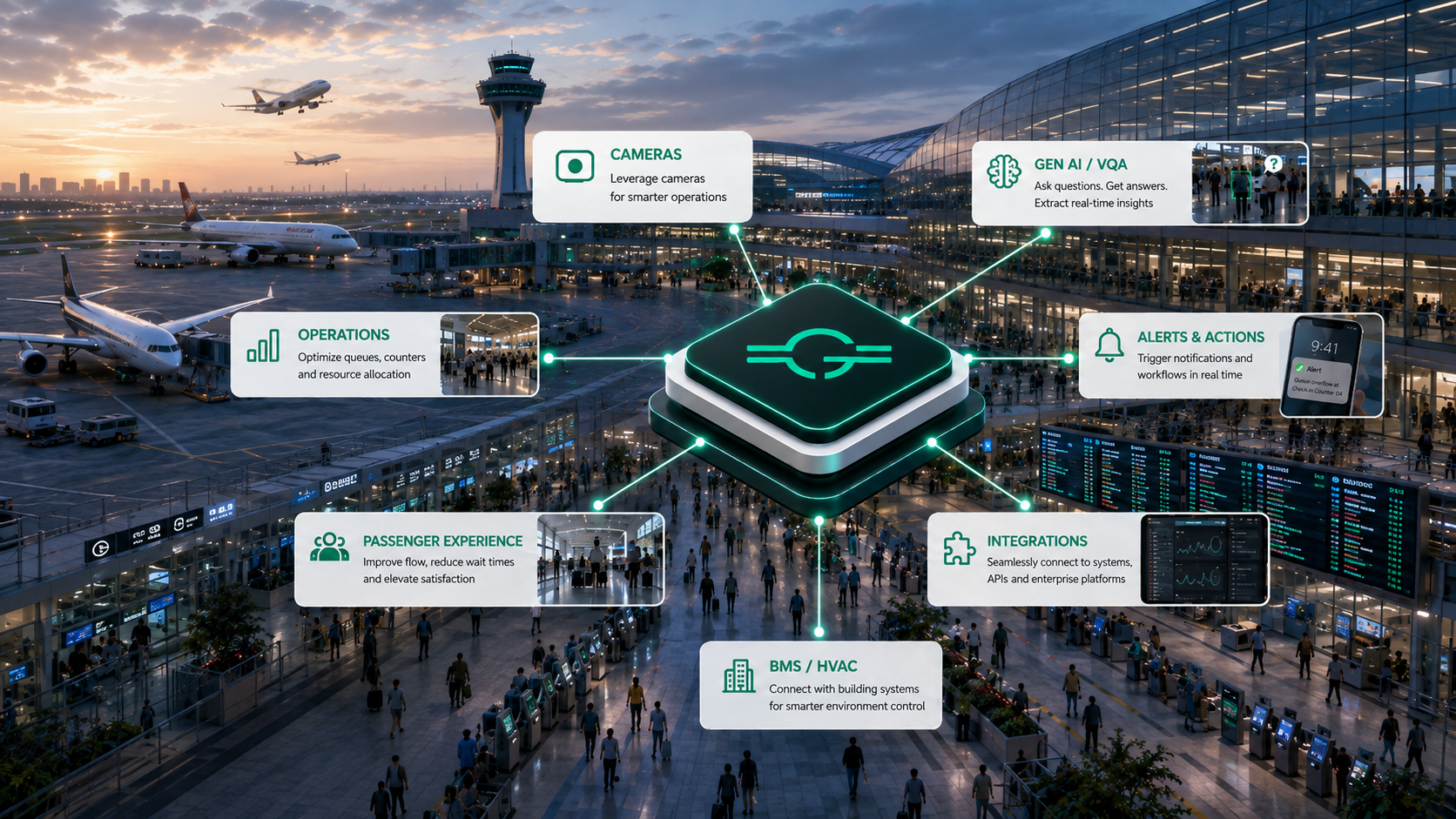
Airports already have extensive camera coverage across check-in halls, baggage areas, passenger corridors, service counters and restricted operational zones.
The bigger opportunity is not always to deploy more cameras. It is to extract more operational value from the infrastructure already in place.
Traditional computer vision has already proven its value for well-defined tasks such as people counting, intrusion detection, line crossing and object detection. Vision Question Answering, or VQA, adds a different capability: the ability to ask more contextual questions about a scene using natural language.
That flexibility becomes commercially interesting when paired with an orchestration layer like Gravio.
Instead of treating video analytics as a standalone system, organizations can use existing camera feeds as another source of operational data—alongside sensors, APIs, MQTT messages and enterprise systems—and connect those observations directly to workflows.
The result is a more flexible model:
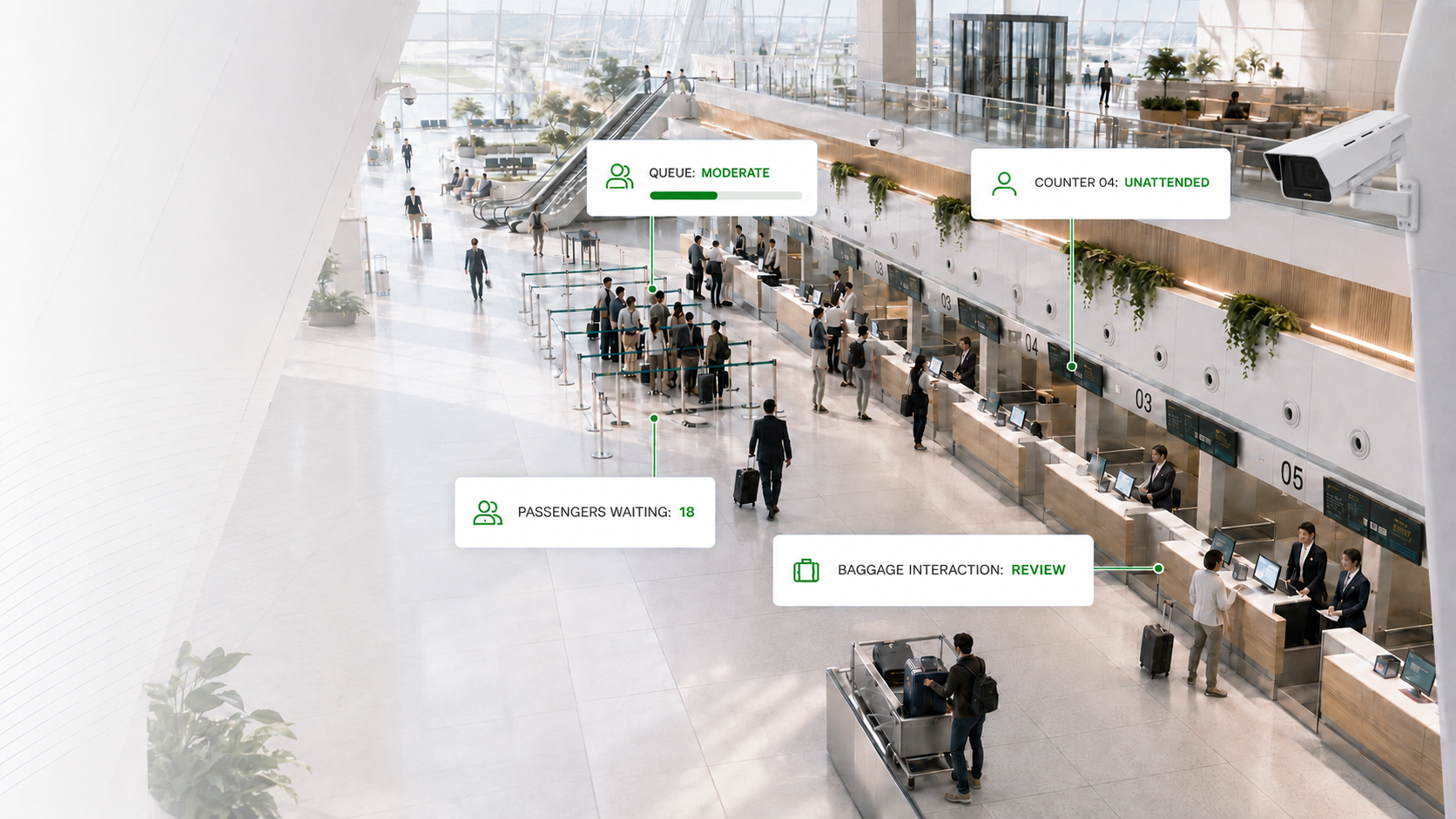
VQA should not be positioned as a replacement for traditional computer vision.
Traditional computer vision remains the better choice when the task is stable, repetitive and clearly defined.
If an airport needs to count people crossing a line, detect intrusion into a restricted area or identify a known object class, a dedicated analytics model can often do that faster and more predictably.
VQA becomes useful when the question is more contextual.
For example:
These are not always difficult because the objects are hard to see.
They are difficult because the meaning depends on the relationship between people, objects and the surrounding environment.
This makes VQA especially useful for:
The commercial benefit is flexibility.
Organizations can investigate new visual use cases faster without treating every new requirement as a custom computer-vision development project.
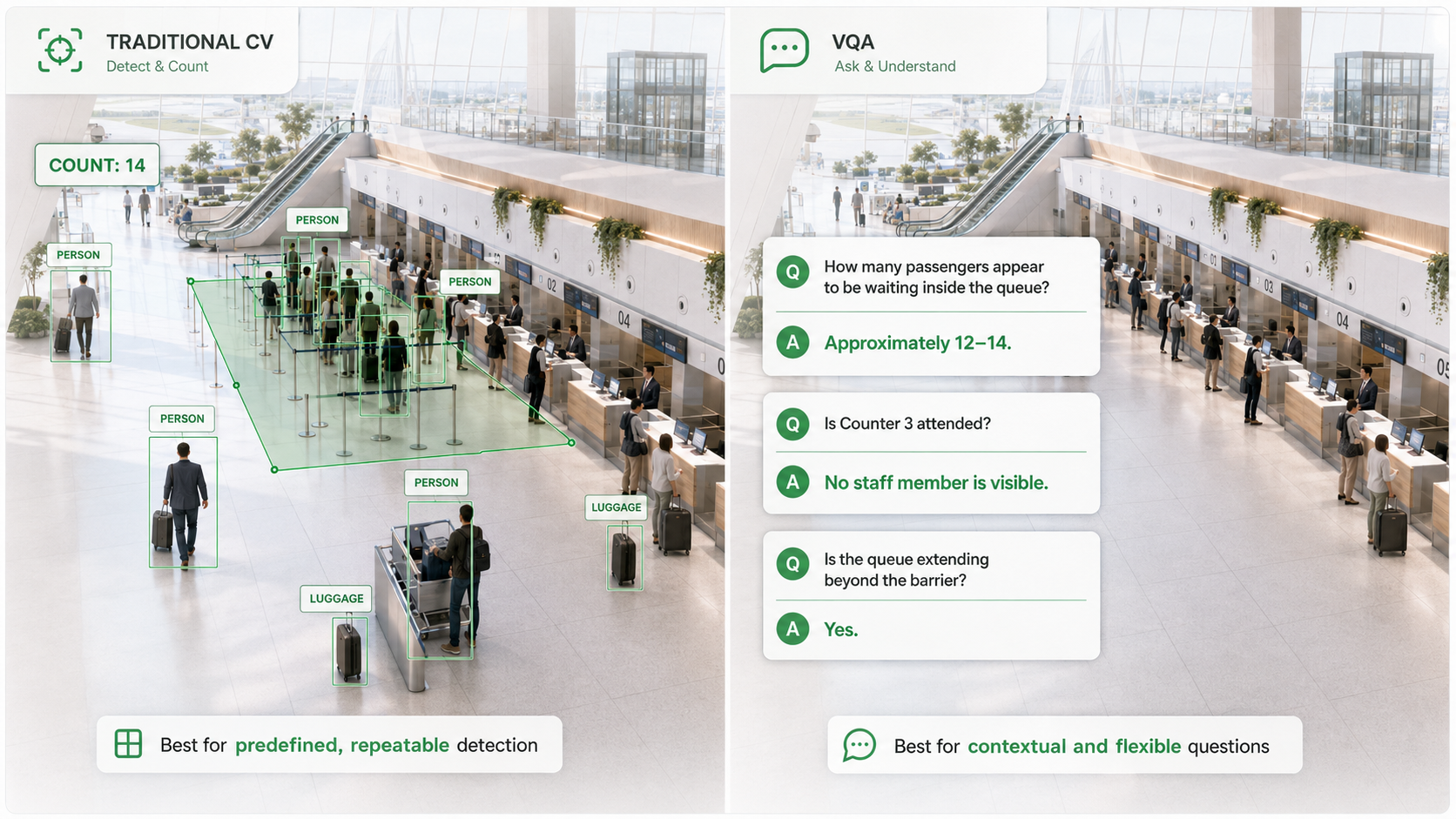
A VQA model can interpret a scene, but interpretation alone does not create an operational workflow.
Gravio provides the layer that connects visual intelligence to business logic and action.
It can determine when an observation is relevant, whether additional validation is required, and what should happen next.
For example, Gravio can apply zone rules, time conditions, repeated observations or additional sensor data before triggering an alert or downstream workflow.
This is particularly important when combining traditional computer vision with VQA.
A conventional model might provide a reliable people count, while VQA adds contextual interpretation such as whether the queue is extending beyond a designated area. Gravio can bring both results together and apply the operational rule.
VQA provides the observation. Gravio determines when that observation becomes an operational event.
That is the core value Gravio adds: not merely connecting systems, but turning visual intelligence into something operations teams can use.
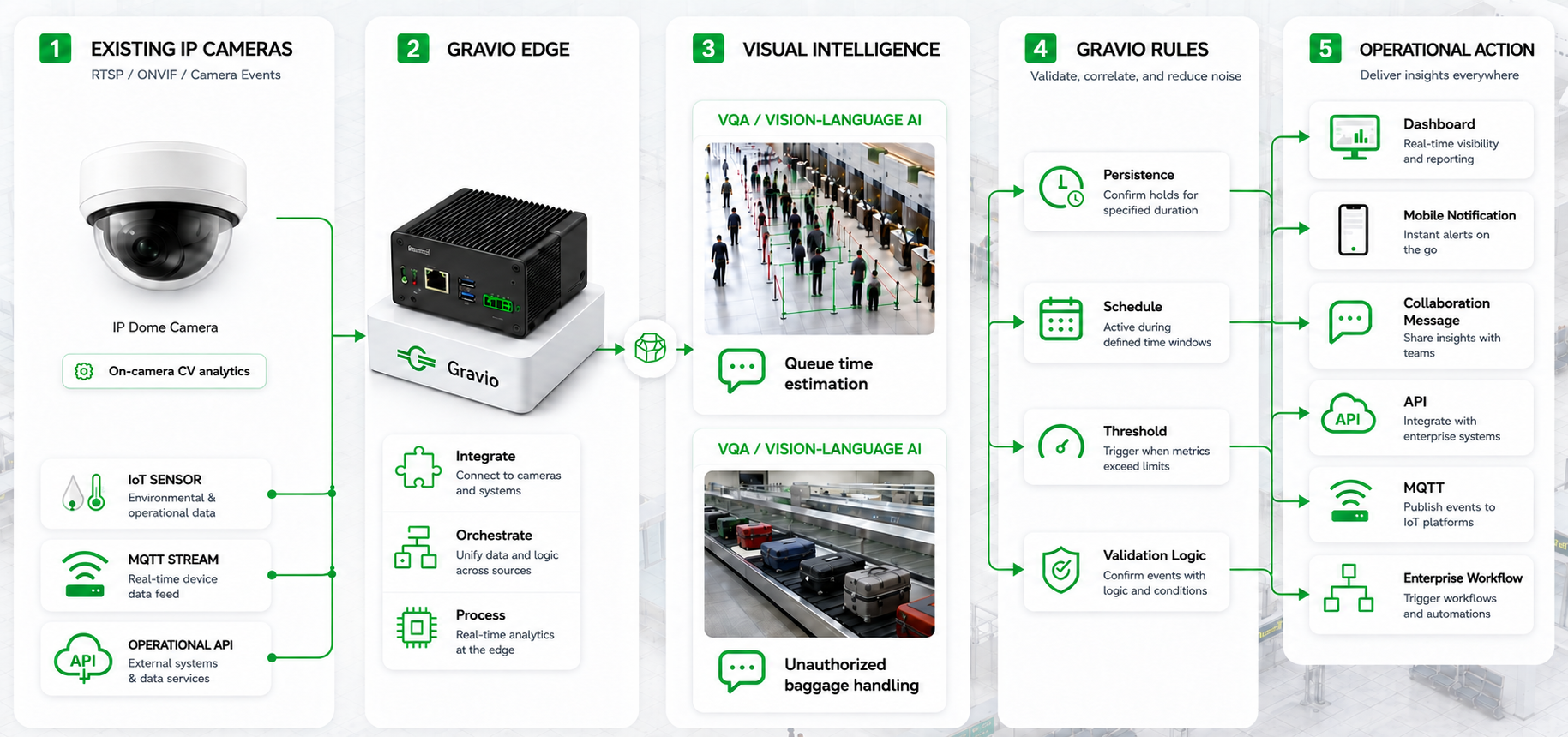
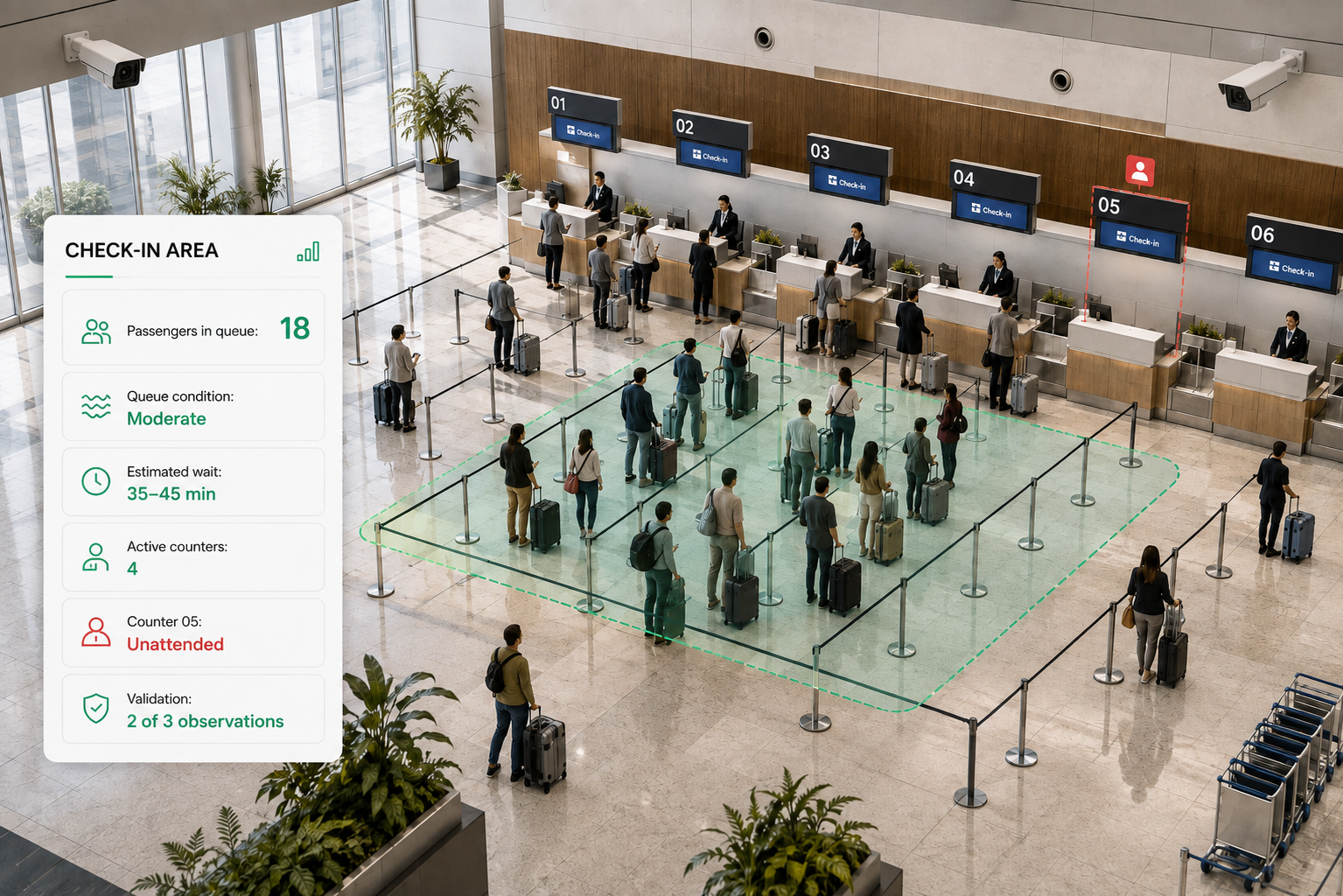
Check-in operations are a good example of where traditional computer vision and VQA can work together. A dedicated people-counting model may already provide a reliable count of visible passengers, while VQA can add context to that number by helping determine which passengers are actually inside the queue barriers, whether the queue appears short, moderate or long, whether a counter is unattended, whether staff are actively serving passengers, or whether the queue is spilling into another area.
Gravio can then combine those observations with operational logic. For example, if a queue appears long, the condition persists across several observations, and too few counters appear to be active, Gravio can trigger a notification to the operations team. This is where the value moves beyond monitoring: the system is no longer just producing analytics, but helping airport teams prioritize attention and respond earlier.
Waiting-time estimation can also be added as a further layer. A simple early-stage model could use:
Estimated wait = Passengers ahead × Average processing time ÷ Active counters
For example, if 10 passengers are ahead, the average transaction takes five minutes, and two counters are actively serving the queue:
10 × 5 ÷ 2 = 25 minutes
A production deployment could later improve this estimate by incorporating counter availability, actual transaction times and observed throughput. The important point is that the architecture can evolve over time without requiring the entire solution to be redesigned.
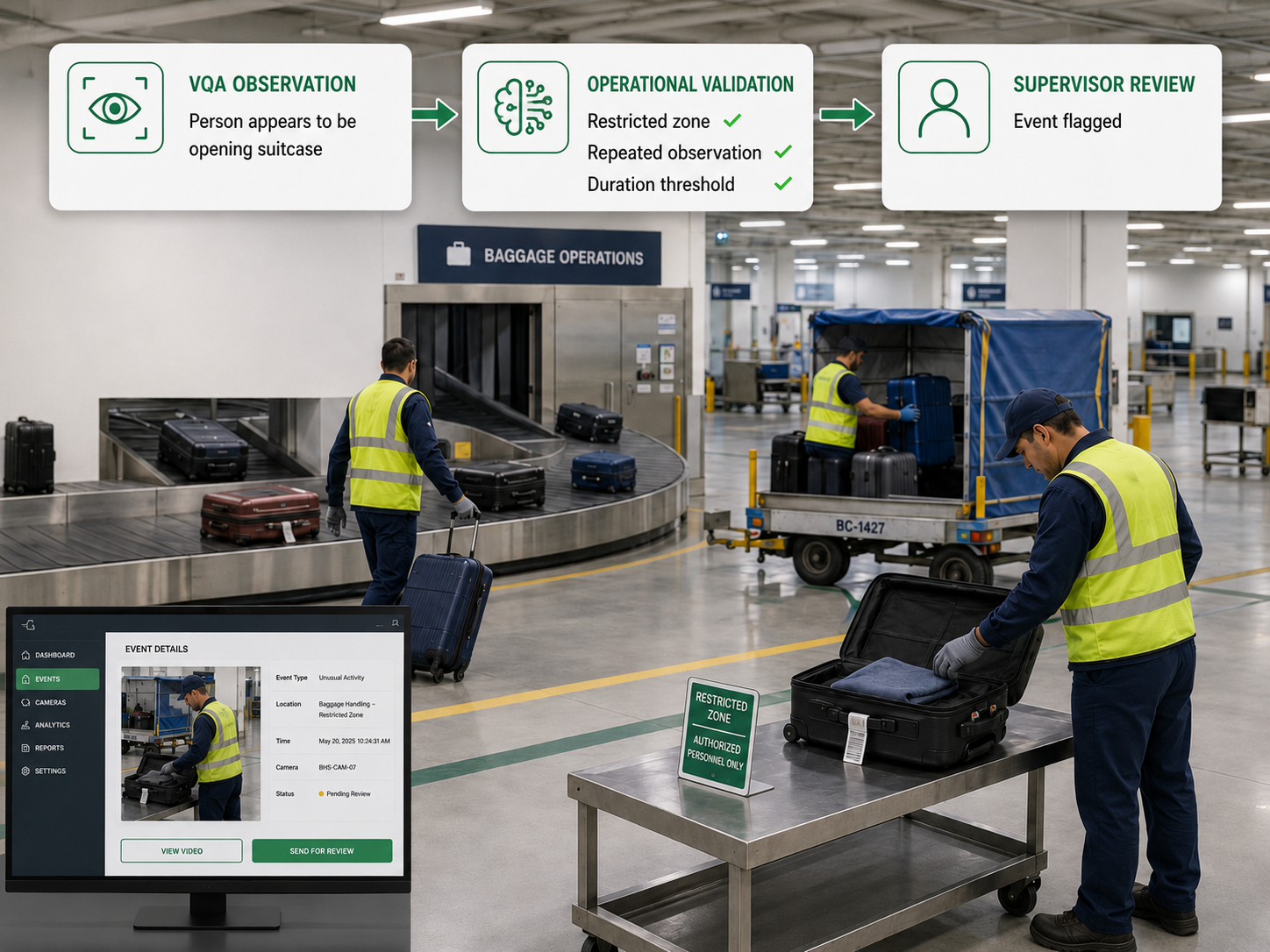
Baggage handling is a good example of why VQA is useful, but also why it should work together with operational rules rather than make decisions on its own. Instead of asking a broad question such as “Is anyone behaving suspiciously?”, which requires the model to infer intent, it is more effective to focus on observable actions.
For example, VQA can help identify whether someone appears to be opening a suitcase, reaching inside an open bag, interacting with a zipper or lock, or handling luggage in an unusual way. These are specific conditions that can be observed without asking the AI to judge motive or wrongdoing.
Gravio can then apply the relevant operational context. If VQA detects that a person appears to be opening luggage, Gravio can evaluate whether the event occurred in a restricted handling zone, whether the same condition has appeared repeatedly, and whether it has persisted long enough to require attention.
If those conditions are met, the event can be escalated to the appropriate team for review. This creates a stronger and more practical model: VQA describes what is happening, while Gravio determines when that observation becomes operationally relevant.
It also keeps the business logic under the airport operator’s control, making the solution easier to adapt to different locations, procedures and escalation requirements.
One of the strongest commercial advantages of VQA is the speed at which new ideas can be tested. Traditional computer vision often requires the problem to be defined very precisely before deployment, which makes sense once the business requirement is mature. In many operational environments, however, new opportunities begin as questions rather than fully specified use cases.
Could we detect unattended service counters? Could we identify queues forming outside designated areas? Could we monitor whether baggage is being opened, or whether a corridor is becoming obstructed? VQA makes it possible to explore these ideas quickly using natural-language questions, without committing immediately to a dedicated computer-vision project.
Once a use case proves valuable, the organization can decide how best to scale it. Some scenarios may remain well suited to VQA, while high-volume or highly standardized tasks may justify a dedicated computer-vision model.
The progression becomes:
This reduces the risk of over-engineering too early and gives airport operators and solution partners more flexibility to experiment with new services using the camera infrastructure they already own.
The commercial value becomes much stronger when visual intelligence is connected to the wider airport environment. Gravio can combine camera observations with:
This allows visual events to become part of a broader operational workflow rather than remain as isolated alerts.
For example, a queue alert could be triggered only during a specific operating period, a visual obstruction could be validated against another sensor or system, and a baggage-related event could require repeated confirmation before escalation. Once the relevant conditions are met, Gravio can trigger the appropriate response, whether that is a dashboard update, messaging alert, API request or local device action.
This is where the architecture becomes reusable. The value is not in delivering one airport AI application, but in creating multiple operational workflows on top of the same integration layer, allowing airports to extend new use cases over time without rebuilding the underlying system.
The strongest airport architecture is unlikely to depend on a single form of AI. Instead, it should use the right tool for the right task.
Traditional computer vision is well suited to use cases where events are clearly defined, processing needs to happen frequently, or consistent and deterministic outputs are important. VQA is better suited to situations where the question is more contextual, requirements are still evolving, rapid experimentation is valuable, or building a dedicated model would be excessive.
The two approaches can also complement each other. For example, a conventional model may determine that 18 people are present, while VQA adds context by identifying that only 12 appear to be waiting inside the designated queue. Similarly, a traditional analytics engine may detect motion in a baggage area, while VQA adds context by identifying that a person appears to be opening a suitcase.
Gravio can then bring these observations together and apply the operational logic around them, determining when an event matters and what action should follow.
This creates a pragmatic path to AI adoption: preserve what already works, add contextual intelligence where it creates value, and avoid rebuilding the technology stack every time a new use case emerges.
Airports have already invested heavily in cameras and visual infrastructure. The next step does not necessarily need to begin with more hardware. It can begin by making the existing camera estate more useful.
Traditional computer vision provides fast, proven analytics for clearly defined tasks. VQA adds flexibility for more contextual questions and emerging use cases. Gravio connects those observations to operational rules, systems and actions at the edge.
Together, they provide a practical path for expanding visual intelligence incrementally: preserve the existing video environment, add contextual AI where it creates value, and connect insights directly to operational workflows without turning every new idea into a custom software project.
Gravio — the platform for automation, integration and innovation at the edge.


