

Part of the Physical AI Series
This article builds on the previous articles in our Physical AI series, where we introduced the fundamentals of Physical AI, explored its architecture, and explained why edge and hybrid deployments have become essential for real-world applications.
Building a Physical AI proof of concept has never been easier. Scaling one into a production system has never been more challenging.
Advances in artificial intelligence, computer vision, edge computing, and IoT have enabled organizations to deploy Physical AI solutions in a matter of weeks. AI models can detect objects, monitor equipment, identify safety risks, and automate routine decisions with remarkable accuracy.
Yet despite these technological advances, many Physical AI projects never progress beyond the pilot stage.
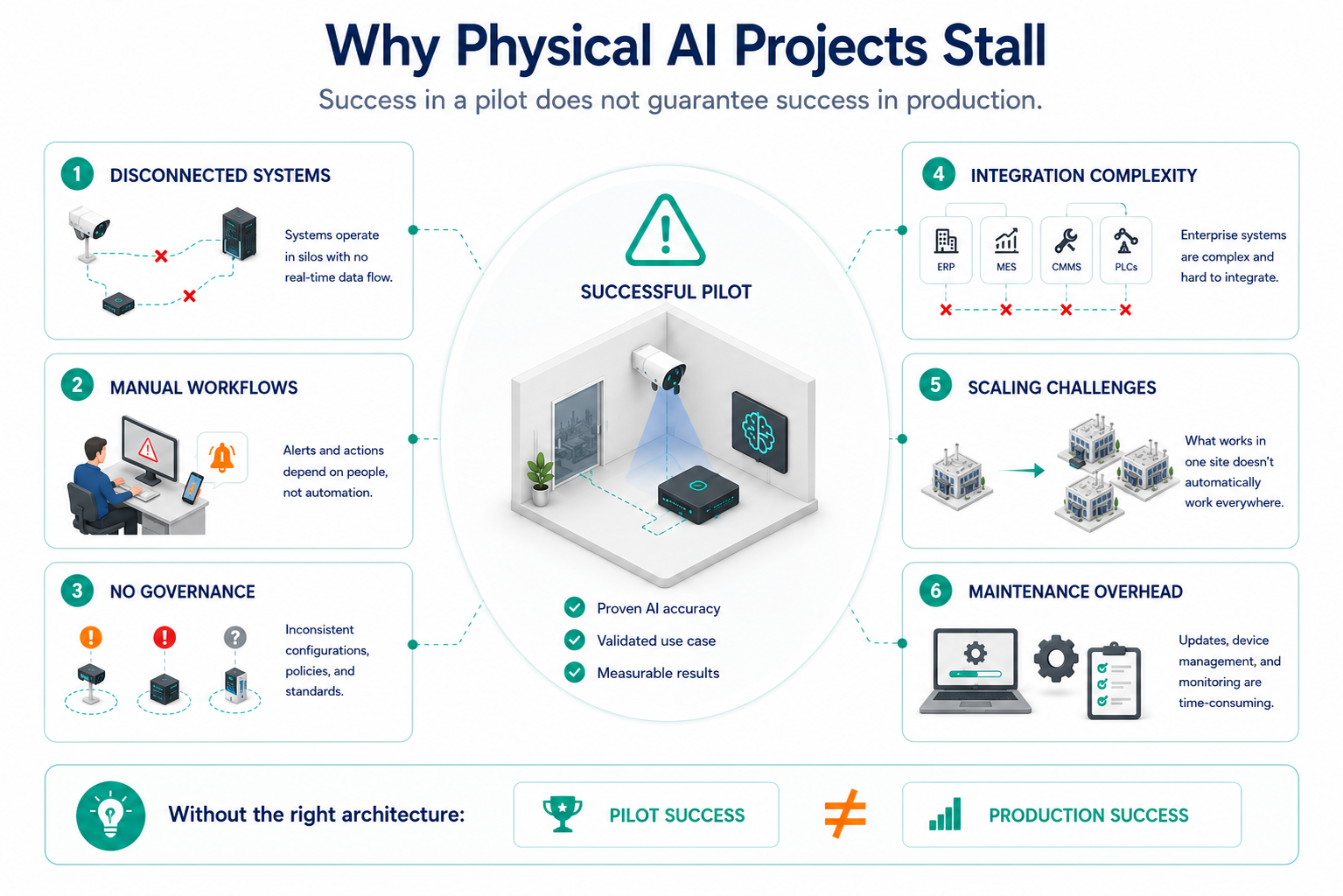
The challenge is rarely the AI model itself. In many cases, the proof of concept performs exactly as intended, successfully solving a specific technical problem. The real challenge begins when organizations attempt to deploy that solution across multiple facilities, integrate it with existing operational systems, and manage it as part of everyday business processes.
A pilot typically contains one camera, one AI model and one workflow.
A production deployment may contain:
Now people suddenly understand scale.
Scaling Physical AI requires more than accurate AI models. It requires an operational architecture designed for integration, orchestration, governance, and long-term evolution.
A successful proof of concept is designed to answer a single question:
Can this technology solve this problem?
A production deployment answers a very different question:
Can this solution operate reliably, securely, and consistently across the business?
This distinction is often underestimated.
A proof of concept might involve a single camera, one AI model, and one notification workflow running in a controlled environment. It demonstrates technical feasibility but rarely addresses the broader operational requirements of a production deployment.
As organizations begin to scale, challenges that were invisible during the pilot quickly emerge:
The architecture that succeeds in a pilot is rarely the same architecture that succeeds in production.

The Most Common Reasons Physical AI Projects Stall
Although every deployment is different, the same patterns appear repeatedly across industries.
One of the most common issues is that projects are designed around individual technologies rather than complete operational workflows. A camera detects an event, an AI model classifies it, and an alert is generated. Technically, the solution works.
Operationally, however, the process often remains incomplete.
Many deployments still rely on people to acknowledge alerts, notify the appropriate teams, update business systems, and coordinate the response manually. The AI generates valuable information, but the surrounding operational workflow has not been automated.
Another challenge is fragmented architecture. Cameras, sensors, PLCs, industrial equipment, and enterprise applications frequently operate as isolated systems with limited ability to exchange information. As additional devices and applications are introduced, the number of point-to-point integrations grows rapidly, increasing complexity, maintenance effort, and operational risk.
What begins as a simple proof of concept gradually becomes an ecosystem of disconnected technologies that is increasingly difficult to manage, extend, and govern.
Organizations also tend to underestimate production requirements such as centralized device management, governance, cybersecurity, software updates, and long-term lifecycle support. These concerns may have little impact during a small pilot but become essential when deployments expand across multiple facilities.
Ultimately, the obstacle is rarely AI performance. It is the absence of a scalable operational architecture capable of coordinating people, devices, applications, and business processes.
Most organizations have already invested heavily in operational technology and enterprise software.
A successful Physical AI deployment rarely starts with a blank slate. Instead, it must integrate with existing systems such as:
This means Physical AI rarely replaces existing systems. Instead, it extends them by adding intelligence and automation to established operational workflows.
Without integration, even highly accurate AI becomes another isolated application that generates alerts but fails to improve operational outcomes.
The objective is not simply to detect events. It is to ensure those events automatically trigger the appropriate business processes across existing operational systems.
Throughout this series, orchestration has appeared repeatedly, whether discussing the Physical AI stack, edge computing, or production deployments. This is not accidental.
As Physical AI systems become more sophisticated, orchestration evolves from a convenience into the architectural layer that enables intelligence to operate reliably across the entire environment.
An orchestration layer coordinates events from multiple sources, applies business logic, invokes AI models when required, and triggers actions across operational systems. Rather than creating isolated automations for individual use cases, it provides a common framework for connecting people, devices, AI services, and enterprise applications.
Equally important, orchestration separates business logic from individual devices and AI models. As hardware evolves, AI services improve, or operational requirements change, organizations can introduce new capabilities without redesigning the underlying architecture.
This flexibility enables Physical AI deployments to grow incrementally while maintaining consistency across distributed environments.
It is often the difference between a successful demonstration and a sustainable operational capability.
Scaling Physical AI requires more than deploying AI models. It requires a platform capable of connecting devices, coordinating workflows, and integrating with existing operational systems.
Gravio provides the orchestration and edge computing capabilities required for production-scale Physical AI deployments. Rather than replacing existing infrastructure, it connects cameras, sensors, industrial equipment, AI services, and enterprise applications within a unified event-driven architecture.
By abstracting integration complexity and enabling reusable workflows, Gravio allows organizations to move beyond isolated proofs of concept and build scalable Physical AI capabilities that evolve alongside changing operational requirements.
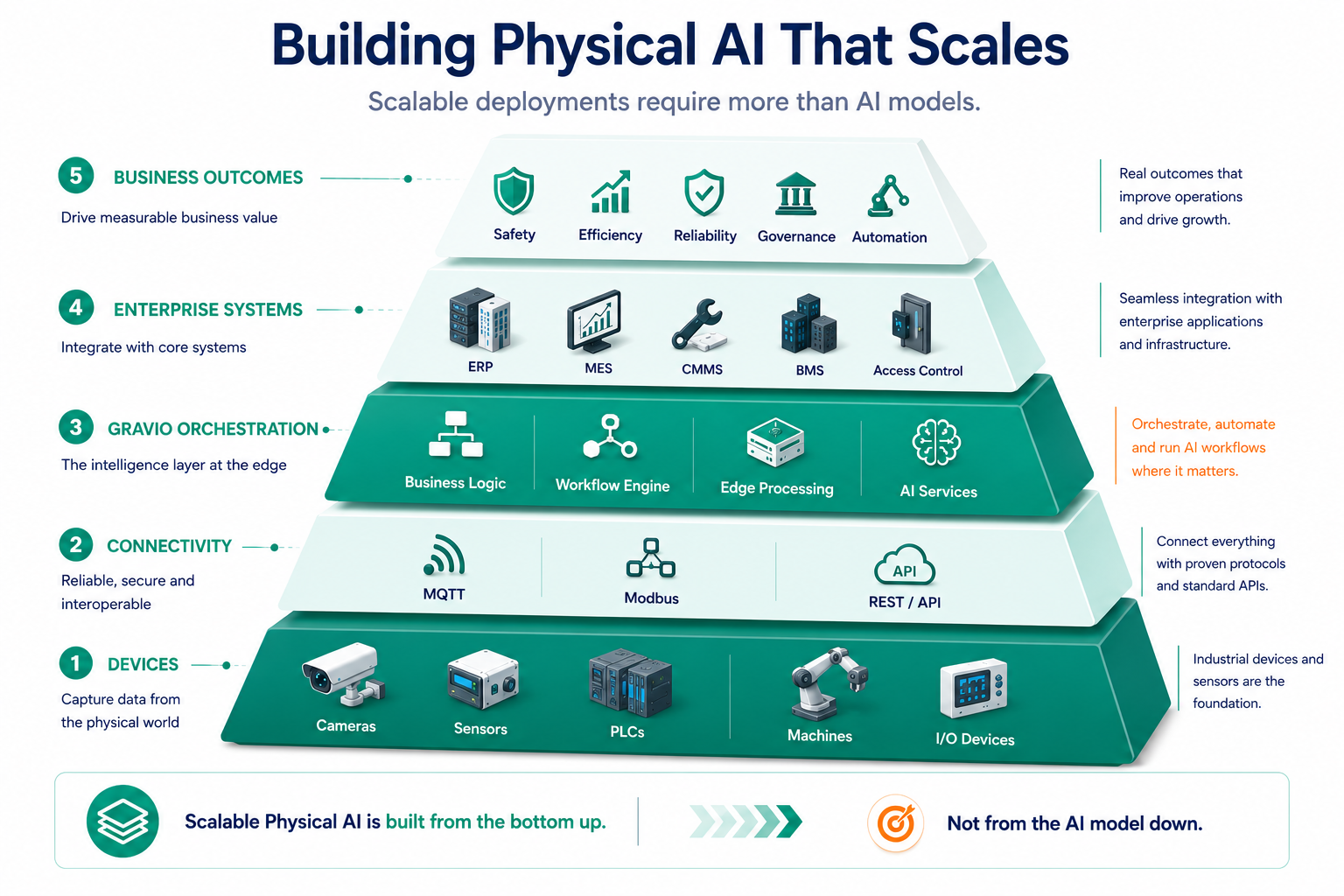
Most Physical AI proofs of concept do not fail because the technology is incapable. They fail because they are designed to demonstrate a capability rather than operate as part of a larger operational ecosystem.
Organizations that successfully scale Physical AI take a different approach. They design for integration instead of isolation, orchestration instead of point-to-point automation, and operational outcomes instead of technical demonstrations.
By treating Physical AI as a long-term operational capability rather than a collection of individual AI projects, they create a foundation that can evolve from a single deployment into an enterprise-wide intelligent automation platform.
AI alone does not scale. Operational architecture does.
In the next article, we will explore orchestration in greater depth and examine why it has become one of the most important, and often overlooked, layers in modern Physical AI architectures.
Subscribe to our newsletter if you wish to stay in the loop.


