AI Readiness Assessment: A Practical Guide for Businesses
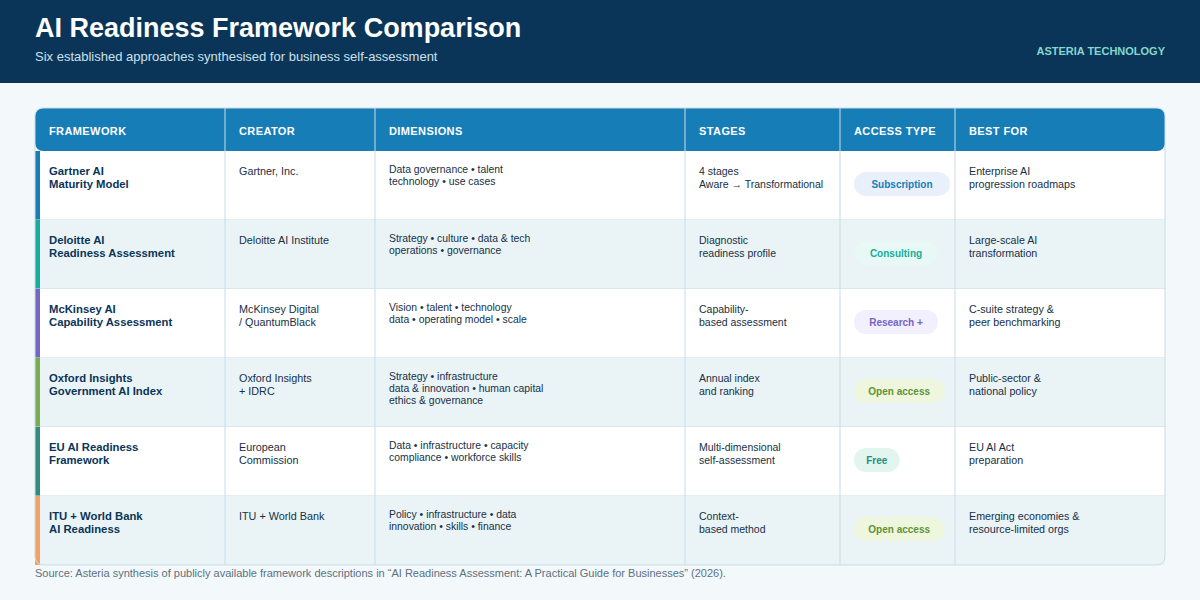
AI readiness is the capacity to adopt, integrate and derive sustained value from AI. This guide distils six established frameworks from Gartner, Deloitte, McKinsey, Oxford Insights, the European Commission and the ITU into one practical six-dimension model, with a self-assessment scorecard and a roadmap for whatever score you land on.
Six Frameworks, One Practical Model for Assessing Whether Your Organization Is Ready for AI
The question isn't if artificial intelligence will transform your business — it's how ready you are when it does.
Organizations across every industry are grappling with the same challenge: AI presents an enormous opportunity, but the gap between ambition and execution is wider than most leaders realize.
According to McKinsey's research on the state of AI, organizations are moving from experimentation to operationalization. The pace and success of that transition varies dramatically, and the difference between those that capture value and those that don't often comes down to one factor: readiness.
This guide distils six established AI readiness frameworks from the world's leading consultancies, research bodies and international organizations into a practical, actionable approach any organization can follow — whether you are a small business taking your first steps or a large enterprise scaling AI across operations.
What Is AI Readiness?
AI readiness is the capacity of an organization to adopt, integrate and derive sustained value from artificial intelligence. It goes beyond simply having data scientists on staff or buying cloud computing credits.
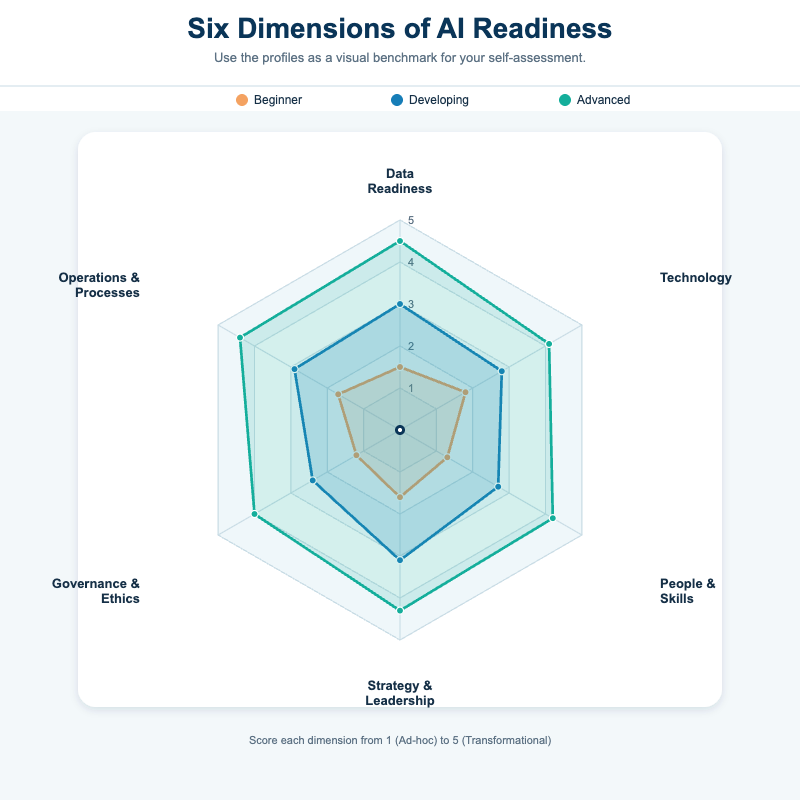
It encompasses six interconnected dimensions:
Data — the quality, accessibility and governance of your information assets
Technology — your infrastructure's ability to support AI workloads
People & Skills — the talent, literacy and culture across your organization
Strategy & Leadership — executive alignment, clear use cases and resourcing
Governance & Ethics — risk management, compliance and responsible AI practices
Operations & Processes — the maturity and agility of your existing workflows
AI readiness differs from general digital readiness because AI introduces unique challenges: model governance, algorithmic bias, data pipeline complexity, regulatory uncertainty, and the need for continuous model monitoring and retraining.
Why Readiness Assessments Matter
Without a structured assessment, organizations risk:
Wasted investment — spending on tools before the foundational data and processes are in place
Regulatory exposure — deploying AI systems that violate emerging regulations like the EU AI Act
Talent misalignment — hiring data scientists without the infrastructure or use cases to support them
Reputational damage — launching biased or unreliable AI systems
The most successful AI adopters don't start with the technology. They start with honest self-assessment.
Six Established AI Readiness Frameworks
1. Gartner AI Maturity Model
Creator: Gartner, Inc. (analyst and research firm)
Gartner's AI maturity model evaluates organizations across four stages of AI adoption, examining dimensions including data governance, talent, technology infrastructure and use case portfolio.
Structure:
Aware — the organization understands AI potential but has limited or no implementations
Active — initial pilots and experiments are underway; learning what works
Operational — AI is deployed in production, generating measurable value
Transformational — AI drives business model innovation and strategic advantage
Assessment approach: A survey-based evaluation benchmarked against peer organizations across industries. Gartner's model is particularly valued for its structured progression path — each stage has defined capabilities that must be in place before advancing.
Best for: Large enterprises with existing AI programs seeking a structured progression roadmap.
Access: Gartner clients can access the framework through their subscription. Non-clients can reference Gartner's published strategic technology trends for AI-related insights.
2. Deloitte AI Readiness Assessment
Creator: Deloitte Consulting / Deloitte AI Institute
Deloitte's framework evaluates AI readiness across five interconnected dimensions: Strategy, Culture, Data & Technology, Operations, and Governance.
Key assessment areas:
Leadership alignment and AI vision clarity
Workforce readiness and change management capacity
Data infrastructure quality and accessibility
Ethical AI governance frameworks
Operational integration capabilities
Assessment approach: Deloitte conducts diagnostic workshops combined with a scoring matrix that produces a structured readiness profile. The framework emphasizes that AI readiness is not just a technology challenge — cultural readiness and leadership alignment are equally critical enablers.
Best for: Organizations planning large-scale AI transformation programmes that need both strategic and operational readiness evaluation.
Access: available through Deloitte consulting engagements.
3. McKinsey AI Capability Assessment
Creator: McKinsey & Company / McKinsey Digital / QuantumBlack
McKinsey's AI capability assessment evaluates organizations across a comprehensive set of dimensions: strategic vision, talent and skills, technology stack, data foundations, operating model and scaling capabilities.
What makes it distinctive: McKinsey's research consistently tracks global AI adoption trends, providing benchmarking data from thousands of organizations worldwide. Their State of AI reports provide comparative context, showing how your readiness measures against industry peers.
Key findings from McKinsey's research:
Organizations with mature AI capabilities report significantly higher returns from AI investments
The gap between AI leaders and laggards is widening
Successful organizations invest across all capability dimensions simultaneously, not sequentially
Scaling AI requires both technology and operating model transformation
Best for: C-suite executives and boards looking to build AI capability at enterprise scale, with benchmarking against global peers.
Access: published through McKinsey's QuantumBlack practice and the annual State of AI report series.
4. Oxford Insights Government AI Readiness Index
Creator: Oxford Insights, in collaboration with the International Development Research Centre
Government strategy — national AI policies, funding and strategic vision
Technology infrastructure — computing power, connectivity and digital services
Data & innovation ecosystem — data availability, research capacity and startup ecosystem
Human capital — education, skills and talent pipeline
Ethics & governance — regulatory frameworks, transparency and accountability
What makes it unique: This is one of the few open-access AI readiness assessments. The full report and methodology are freely available, making it an excellent reference point for understanding what comprehensive AI readiness looks like at scale.
The EU's AI Readiness framework provides a multi-dimensional self-assessment tool aligned with the requirements of the EU AI Act.
Key dimensions:
Data availability and quality
Technical infrastructure readiness
Organizational capacity and change management
Regulatory compliance, including EU AI Act obligations
Workforce skills and training
Why it matters now: The EU AI Act establishes a risk-based regulatory framework for AI systems, with significant obligations for organizations deploying high-risk AI. The readiness framework helps organizations assess their compliance posture before deployment.
Creator: International Telecommunication Union (ITU) and World Bank Group
The ITU's AI for Good initiative provides an AI readiness methodology designed for emerging economies and developing organizations.
Key dimensions:
Policy & governance frameworks
Infrastructure and connectivity
Data ecosystems and interoperability
Innovation capacity and entrepreneurship
Digital skills and education
Financial resources and investment
What makes it distinctive: Designed for contexts where infrastructure and resources may be limited, this framework provides a pragmatic starting point for organizations that can't simply buy their way into AI readiness.
Could you explain to a regulator how your AI system makes decisions?
Have you conducted a risk assessment for any AI system you plan to deploy?
Dimension 6: Operations & Processes
AI cannot operate in a vacuum — it must integrate into real business processes.
Process maturity — are your existing workflows documented, standardized and measurable?
Agility — can your organization pilot, test and iterate on new solutions rapidly?
Cross-functional collaboration — do silos between IT, operations and business units block AI integration?
KPI frameworks — do you have metrics to measure AI impact on business outcomes?
Self-assessment questions:
How long does it take to move an AI idea from concept to pilot?
Do your existing processes have documented inputs, outputs and success criteria?
Can your teams collaborate across departments to implement AI solutions?
Self-Assessment Scorecard
How to use: rate your organization on a 1–5 scale for each of the six dimensions — Data Readiness, Technology & Infrastructure, People & Skills, Strategy & Leadership, Governance & Ethics, and Operations & Processes — then take the average as your overall score.
Scoring guide:
Ad-hoc — no systematic approach; isolated experiments
Focus: targeted use cases, proofs of concept, building internal champions
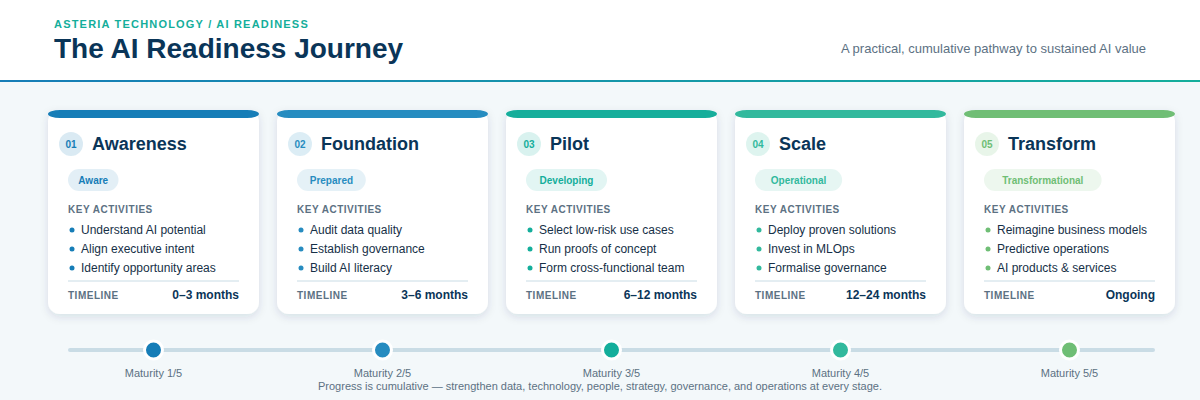
Select two or three high-impact, low-risk AI use cases
Run proof-of-concept projects with clear success criteria
Build a cross-functional AI task force
Establish data pipelines for your pilot use cases
Begin AI ethics and governance framework development
Timeline: 6–12 months
Score 3.5–4: Scaling Phase
Focus: operationalizing AI, expanding use cases, investing in MLOps
Deploy successful pilots into production
Invest in MLOps and model monitoring infrastructure
Expand AI use cases across additional departments
Formalize AI governance with documented policies and review processes
Develop internal AI training programmes for the broader workforce
Timeline: 12–24 months
Score 4–5: Transformation Phase
Focus: AI-driven business model innovation, predictive operations
Embed AI into strategic planning and business model design
Implement predictive and prescriptive analytics across operations
Explore autonomous process opportunities
Develop AI products and services for external customers
Contribute to industry AI standards and best practices
Timeline: ongoing
How Asteria and Gravio Can Help
Assessment is the starting point. The harder question is what to do once you know where the gaps are — and for most organizations, the answer is not to replace the technology stack they already have.
Asteria Technology helps organizations navigate AI adoption with a practical, integration-first approach, with no rip-and-replace of existing IT infrastructure required. Our capabilities include:
AI Readiness Assessment Workshops — tailored evaluations based on the frameworks described above, with actionable roadmaps specific to your organization
System Integration — connecting AI capabilities to your existing ERP, CRM, IoT sensors and operational systems
End-to-End AI Adoption — from strategy and pilot design through to scale and operationalization
On-Premise Secure AI Solutions — for organizations that need AI capabilities without cloud dependency, particularly SMEs and enterprises with data sovereignty requirements
Gravio is the platform that makes that roadmap executable. Several of the six dimensions above are precisely where Gravio operates:
Data readiness — Gravio collects, normalizes and stores data from cameras, IoT sensors, MQTT, APIs and enterprise systems, turning fragmented sources into usable time-series data
Technology & infrastructure — as an edge and hybrid platform, Gravio supports AI workloads on-premise for organizations with data sovereignty or connectivity constraints
People & skills — Gravio's no-code workflow builder lets operations teams build and adapt automations without a dedicated ML engineering team
Operations & processes — Gravio is the orchestration layer that turns an AI observation into an operational event, applying business logic and triggering the right action in the right system
That combination is what moves an organization from a promising pilot to a production capability — the transition where most AI programmes stall.
Ready to Assess Your Organization's AI Readiness?
Score yourself against the six dimensions above, then start with the one that scored lowest. If that dimension involves connecting AI to the systems, sensors and processes you already run, Gravio offers a free trial so you can evaluate it in your own environment.
Contact us for a complimentary AI readiness consultation.
Gravio — the platform for automation, integration and innovation at the edge.
References and Further Reading
This article draws on established frameworks and research from the following organizations:
Airports can unlock more value from camera infrastructure by combining traditional computer vision with VQA for more contextual and flexible use cases. Gravio connects these visual insights with operational systems, applies business logic, and triggers actions, creating a practical way to test, refine, and scale airport AI without rebuilding the entire technology stack.
Monitor equipment temperatures in real time with Gravio and Axis Communications Thermal Cameras. Learn how this no-code edge solution helps manufacturers and facility operators detect overheating early, automate alerts, visualize temperature trends, and improve preventive maintenance while reducing downtime.